
As East and Southeast Asia ages rapidly, a new study involving researchers from Duke Kunshan University, Duke University and Duke-NUS Medical School maps the region’s long-term aging research landscape and identifies gaps in the data needed to support healthy aging.
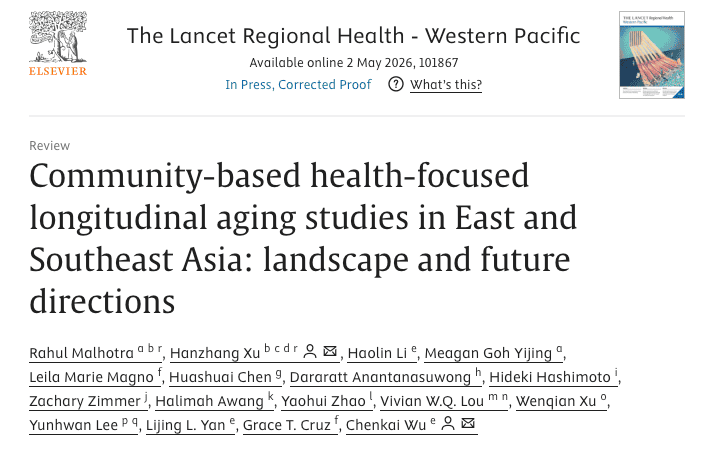
The study, “Community-based health-focused longitudinal aging studies in East and Southeast Asia: landscape and future directions,” was published in The Lancet Regional Health – Western Pacific. It provides an extensive overview of community-based, health-focused longitudinal aging studies across the region and points to gaps in geographic coverage, measurement consistency and data access.
The study’s co-first authors are Rahul Malhotra, associate professor and executive director of the Centre for Ageing Research & Education (CARE) at Duke-NUS Medical School, and Hanzhang Xu, associate professor in the Duke University School of Nursing. Xu and Chenkai Wu, associate professor of global health at DKU, are co-corresponding authors. Lijing Yan, professor of global health at DKU, and Haolin Li, a former student in DKU’s Master of Science in Global Health program, as well as Meagan Goh, a research assistant at Duke-NUS’ CARE, are also co-authors.
The researchers identified 30 eligible studies across 10 countries, regions or territories, with most concentrated in Japan, Chinese mainland, Singapore and South Korea. No eligible studies were found in several places, including Brunei, Cambodia, Indonesia, Laos, Macao, Mongolia, Myanmar, North Korea and Timor-Leste. The study also found that physical frailty is rarely assessed, data access is inconsistent, and no identified study included participants from more than one country, region or territory.
The findings matter because governments across the region are preparing for older populations that will need different forms of health care, financial support and family caregiving.
Longitudinal studies follow the same people over time. In aging research, they are especially valuable because they can show how health, economic status and well-being change as people grow older. They can help researchers understand broad aging patterns and give policymakers a stronger evidence base for planning.
Wu, a co-corresponding author of the paper, said the findings point to the need for stronger evidence as governments prepare for rapidly aging populations.
“The East and Southeast Asia region is home to the world’s largest and fastest-growing population of older adults,” Wu said. “Decisions made today by governments regarding pension schemes, healthcare infrastructure, and caregiver support will affect billions. Without the longitudinal data this paper tracks, policymakers are essentially flying blind.”
The study shows that aging research in East and Southeast Asia has grown sharply in recent decades. Of the 30 eligible studies identified, 24 were launched in the 2000s, including 13 between 2010 and 2019. Newer studies are more likely to collect biomarkers, physical performance measurements and other detailed health information.
The map, however, remains uneven.
High-income economies, including Hong Kong, Japan, Singapore, South Korea and Taiwan, accounted for 17 of the 30 studies. Chinese mainland was represented by six studies. In Southeast Asia, only the Philippines, Singapore, Thailand and Vietnam had eligible longitudinal aging studies.
The paper also points to gaps in what existing studies measure. Only 12 of the 30 studies included measures of physical frailty, even though frailty is widely seen as an important warning sign for later health risks. The study also found differences in how researchers measure common areas such as cognitive function, physical function, depressive symptoms, quality of life and social connectedness. Those differences make it harder to compare findings across countries.
The authors call for stronger regional coordination, more standardized core health measures and better data-sharing mechanisms. They also recommend expanding aging studies in countries, regions and territories that are now underrepresented, integrating digital health data, improving access to existing data, and building research partnerships that respect local ownership and expertise.
The study grew out of a collaboration across the Duke network. Wu conceptualized the study and served as lead coordinator, bringing together a core writing team from DKU, Duke and Duke-NUS. The project also involved more than 10 regional experts to help ensure that the research situation in each country or territory was represented comprehensively and accurately.
The collaboration highlights the unique strengths of Duke’s three campuses, especially DKU in China and Duke-NUS in Singapore, which play important roles in generating evidence to improve the health of Asian populations across fields including aging research.
“This study required a triangulation of expertise that no single campus could provide in isolation,” Wu said. “Duke provided the deep historical context of longitudinal methodology; Duke-NUS brought unparalleled expertise in the specific aging landscape of Southeast Asia; and DKU served as the bridge to East Asian research networks and the emerging data trends in China.”
“The collaboration across three campuses helped us better understand how ageing differs across cultures and allowed us to develop recommendations that support more meaningful cross-national comparisons,” said Malhotra. “Future efforts should focus on aligning psychosocial and emerging measures — such as frailty, resilience and digital literacy — while retaining flexibility to reflect local contexts and needs.”
The paper concludes that many places in East and Southeast Asia already have important data infrastructure for longitudinal aging studies. At the same time, expertise and infrastructure need to be strengthened in low- and middle-income economies in the region, which will enable more complete, comparable and accessible data to support healthy aging in the region.
The value of these datasets, the authors say, lies in their ability to provide updated, comprehensive and nationally representative evidence on the health, economic status and overall well-being of older adults. By bringing that evidence together, the study helps establish a foundation for more effective, data-driven aging policies across the region.
The authors say that foundation will become increasingly important as countries across the region try to design policies for older populations whose health, economic and caregiving needs may vary widely.