
A new study led by Jingbo Cui, associate professor at Duke Kunshan University’s Environmental Research Center, has found that jurisdictions governed by policymakers who experienced extreme heat early in life had lower carbon emissions.
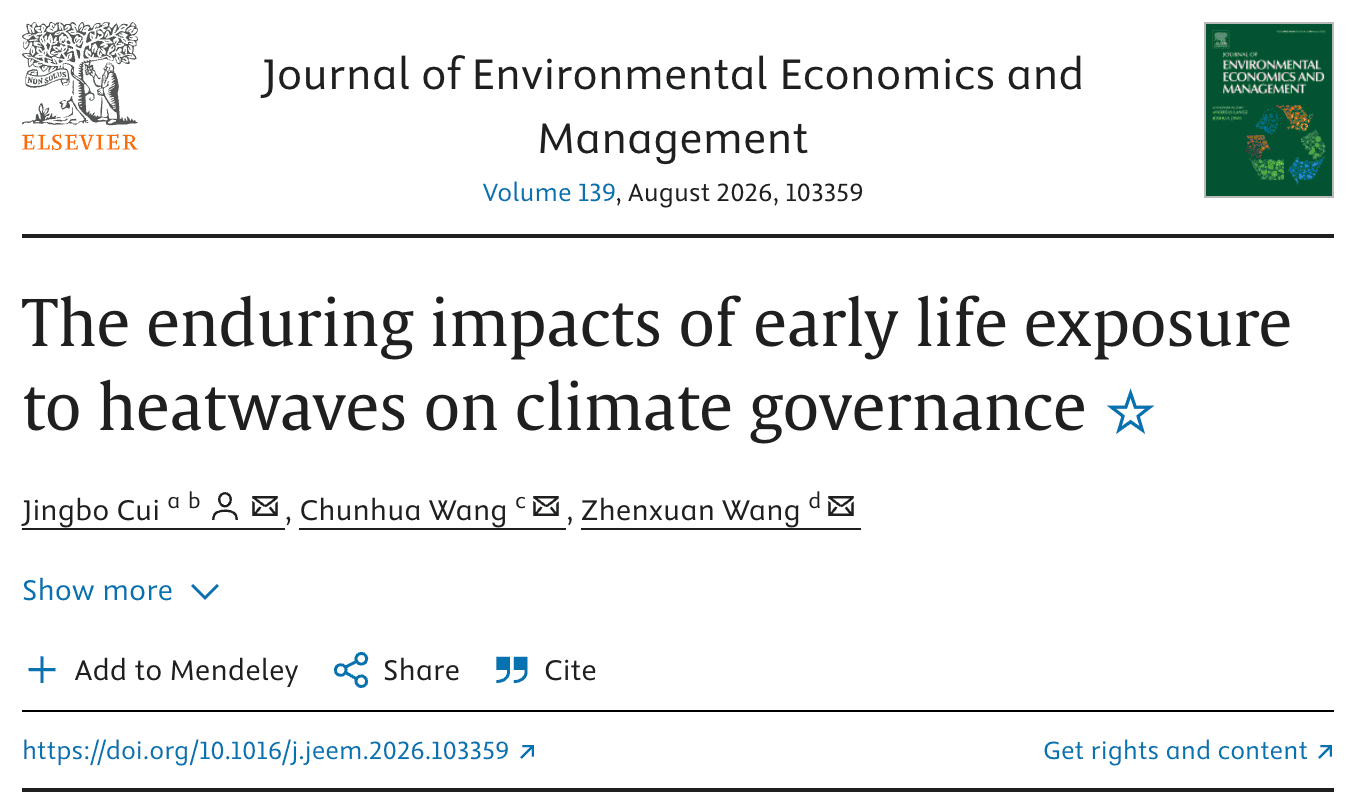
The paper, “The Enduring Impacts of Early Life Exposure to Heatwaves on Climate Governance,” was recently published online in the Journal of Environmental Economics and Management. Combining detailed climate records with the career histories of local government officials, the researchers provide new evidence that early-life climate experiences can have lasting effects on public policy decisions.
Previous research in psychology and economics has shown that experiences during critical developmental periods, particularly adolescence, can shape individuals’ attitudes, preferences and decision-making throughout life. Because policymakers’ personal preferences often influence public policy, the research team sought to examine whether early exposure to climate extremes could affect climate governance decades later.
To investigate this question, the researchers assembled a dataset covering 3,620 local government leaders across 367 Chinese prefecture-level cities between 2000 and 2017. They developed an indicator of early-life heatwave exposure based on climate conditions in officials’ birthplaces and used variations in officials’ career assignments to estimate the long-term effects of those experiences on climate governance.
The researchers found that jurisdictions governed by officials who experienced extreme heat early in life had approximately 1% lower carbon emissions than comparable jurisdictions led by officials without such exposure.

Jingbo Cui
Further analysis suggests that the reduction was driven primarily by changes in regional economic structure rather than improvements in carbon intensity. Areas governed by these officials tended to experience faster growth in the service sector, contributing to lower overall emissions. At the firm level, companies operating in these jurisdictions also exhibited lower carbon emissions.
The findings suggest that personal experiences with climate extremes can shape policymakers’ environmental priorities long after those events occur. By revealing how early-life climate experiences influence governance decisions, the study highlights an often-overlooked human dimension of climate policymaking and offers new insights into the factors that drive long-term climate action.