
A new study by researchers at Duke Kunshan University has found that carbon emissions regulations can lead companies to shift production and emissions to unregulated subsidiaries within the same corporate group, potentially offsetting some of the emissions reductions achieved by regulated firms.
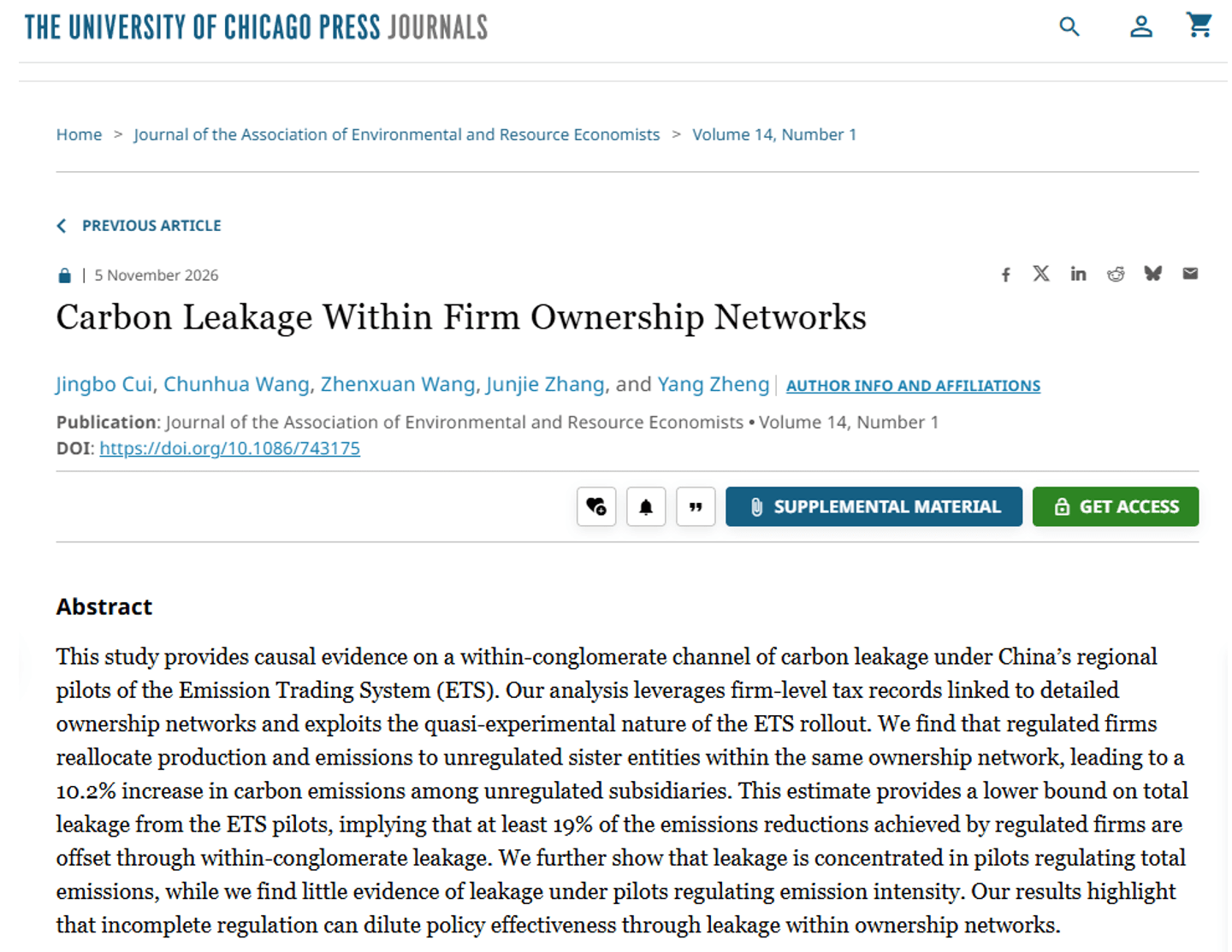
The study, “Carbon Leakage Within Firm Ownership Networks,” was published online on Nov. 5, 2026, in the Journal of the Association of Environmental and Resource Economists. The research was conducted by Jingbo Cui, associate professor at DKU, Junjie Zhang, professor at DKU, and their co-authors Chunhua Wang, Zhenxuan Wang, and Yang Zheng.


Carbon markets are designed to reduce greenhouse gas emissions by putting a price on carbon. However, when regulations cover only certain regions, industries, or companies, regulated firms may shift carbon-intensive production to entities outside the regulatory scope. This phenomenon, known as carbon leakage, can undermine the overall effectiveness of emissions reduction policies.
The research team examined China’s regional emissions trading system (ETS) pilots, which began rolling out in 2013. Combining national firm-level tax records from 2008 to 2015 with detailed corporate ownership information, the researchers constructed a dataset covering 1,246 firms and 7,410 firm-year observations to investigate how carbon regulations affect production and emissions within corporate groups.
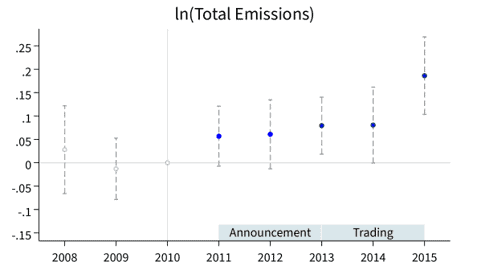
The findings reveal significant carbon leakage within corporate ownership networks. Compared with comparable firms, unregulated subsidiaries experienced an average increase in carbon emissions of 6.4 percent following the announcement of the ETS pilots. During the formal trading period, emissions increased by 10.2 percent. Meanwhile, emissions from directly regulated firms declined by 25.6 percent. The researchers estimate that emissions transferred to unregulated subsidiaries offset at least 19 percent of the reductions achieved by regulated firms.
Further analysis suggests that this leakage was primarily driven by the reallocation of production activities within corporate groups, rather than improvements or declines in production efficiency. Unregulated subsidiaries increased their energy consumption, output, sales, and value added, while their emissions intensity and energy intensity showed no statistically significant improvement.
The study also identifies differences across regulatory approaches. Carbon leakage was significant in pilot programs that allocated allowances based on total emissions, while no statistically significant leakage was found in programs based on emissions intensity. Leakage was also more pronounced among smaller and historically lower-emitting subsidiaries.
The findings highlight the importance of considering corporate ownership networks when evaluating the effectiveness of carbon markets. As China continues to expand its national emissions trading system, understanding how companies reorganize production across affiliated entities will be important for assessing actual emissions reductions. The research offers empirical insights for designing more comprehensive carbon regulations and strengthening the effectiveness of climate policy.