
This story is part of a series featuring members of DKU’s Class of 2026 as they look back on their time at the university and ahead to what comes next.
Qinyu Xu did not expect her future to begin in a math classroom.
Until college, math had been what it is for many students: a subject to work hard at, do well in and move on from. Then she walked into her first math class at Duke Kunshan University.
As the professor worked through formulas and examples on the board, Xu found herself viewing math in a new way. She was no longer focused only on getting the correct answer. What caught her was the logic behind it: the way one idea led to the next, the way a hard problem slowly opened up if she stayed with it long enough. For the first time, math felt less like a school subject and more like a way of thinking.
Soon after, she changed her schedule, trading some of the courses she had planned to explore for more math.
By graduation, Xu had received offers from Duke, Harvard, Yale and Brown, among others. This fall, she will begin a Master of Science program in Computational Biology and Quantitative Genetics at the Harvard T.H. Chan School of Public Health.
Looking back, her path seems clear. At the time, it didn’t.
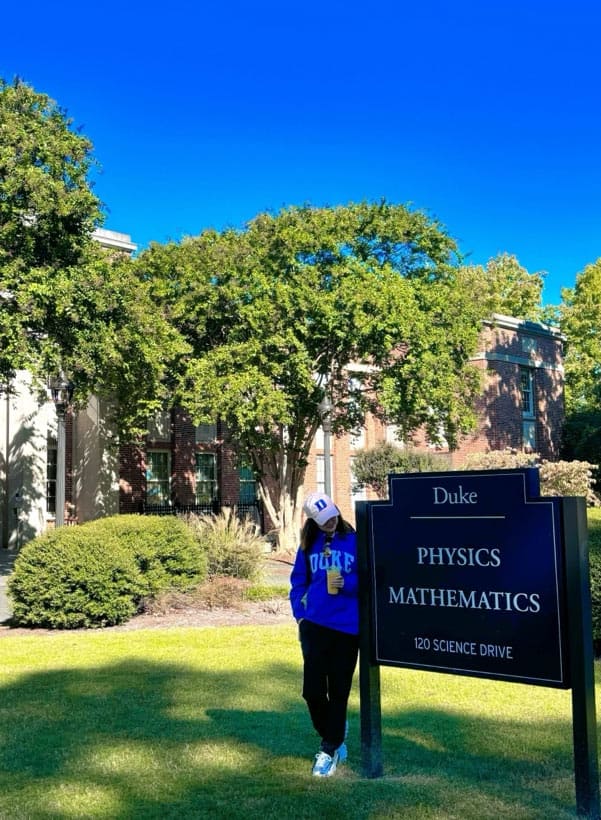
One reason she chose DKU was that it gave her room to explore before deciding exactly what she wanted to do. That freedom mattered. It gave her time to figure out what she really cared about, and once she found it, she kept going.
A mind for hard problems
Xu does not describe herself as the kind of student who hears something once and immediately gets it. Her strength, she says, has always been that she keeps at things. If a concept did not make sense, she kept working at it. If there was a gap in her understanding, even a small one, she wanted to close it.
During her junior year at Duke, where she studied away from DKU, she enrolled in a demanding math course taught at the level of a doctoral qualifying class. Nearly every week, she went to office hours. Sometimes she spent two hours discussing a problem and still left without a full answer. Then she would go back, work through it with classmates and return to it again. By the end of the semester, she had earned an A+.
She took that same approach to helping other students. At DKU, Xu worked as a peer tutor, holding weekly drop-in sessions, answering questions and leading review sessions. Even when she already understood the tutoring materials well, she still reviewed it carefully beforehand. She did not just want to explain an answer. She wanted to help them think their way toward one.
But even as math became central to her college life, it was never the only thing pulling at her.
Long before she chose it as her major, Xu had also been drawn to biology. During the Covid-19 pandemic, questions about illness, medicine and scientific research started to feel much more immediate. She found herself thinking seriously about work that might help people live longer, healthier lives.
So when she committed to math, she did not leave biology behind. Instead, she began asking a different question.
“I started to think maybe I could use math to study the biological questions that interested me,” she said.
At first, she focused on building a strong foundation, spending her first two years on classes rather than rushing into research. Her first research opportunity came later, during her time at Duke, when she contacted Veronica Ciocanel, a professor whose research interests span mathematics and biology.
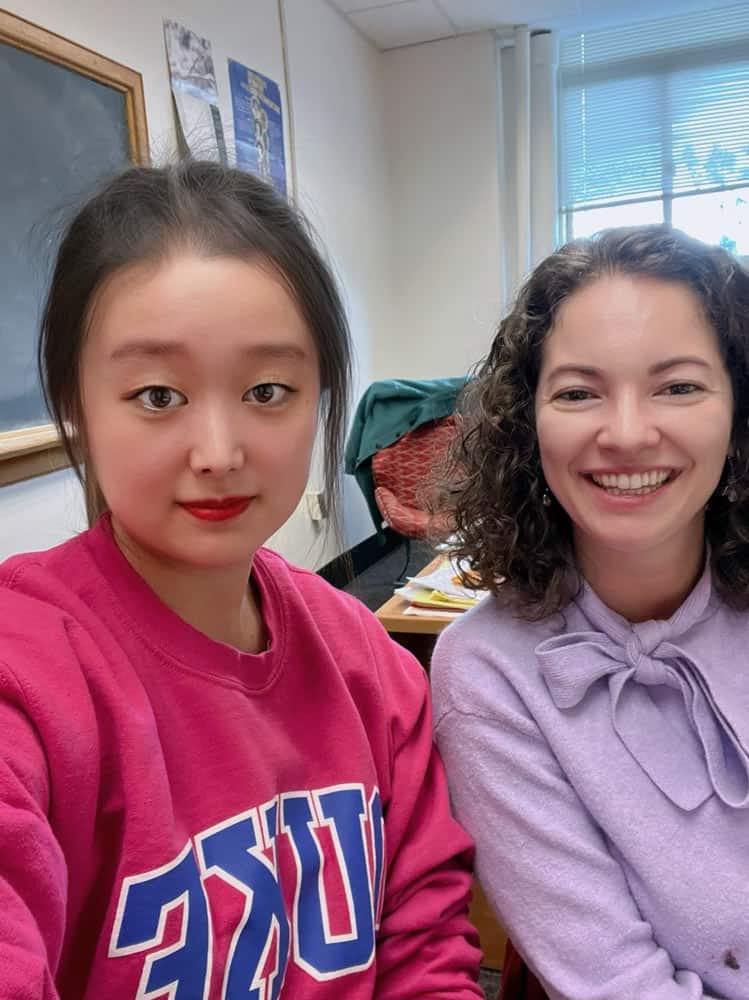
Under Professor Ciocanel’s guidance, Xu spent four months on an independent research project focusing on a biological problem tied to RNA dynamics in Xenopus Oocytes using mathematical modeling. For the first time, she was able to bring together the two fields she cared about most.
Her paper was later published on SIAM Undergraduate Research Online, a journal published by the Society for Industrial and Applied Mathematics. Just as important, the project showed her that she could do serious work that brought math and biology together.
Where the two meet
That first project showed her what was possible. The next one tested how far she could go.
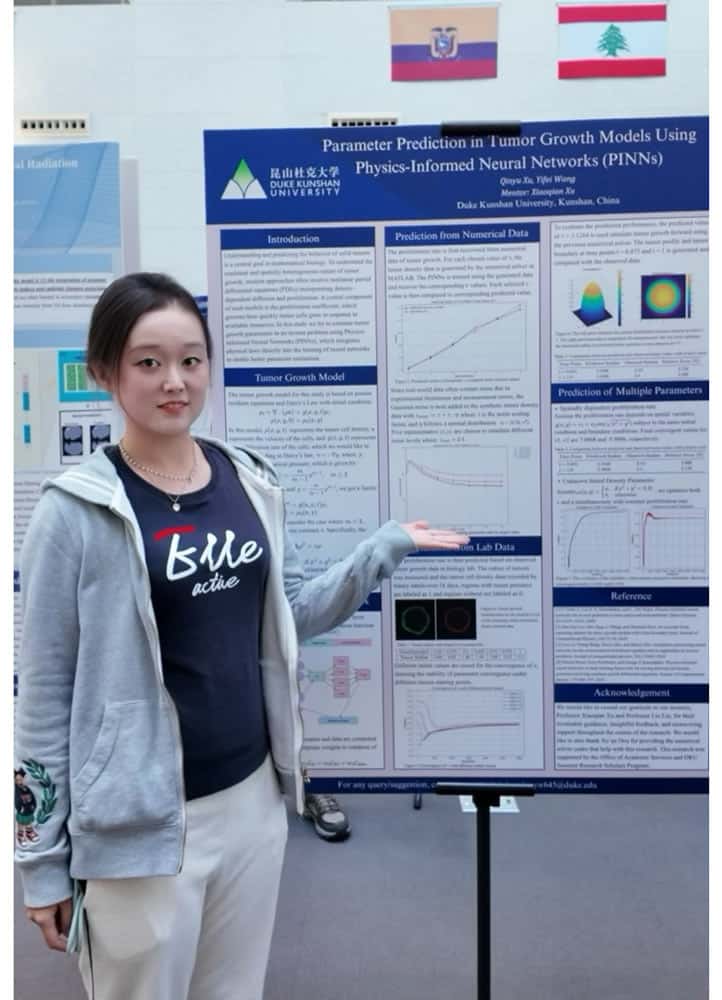
Working with Professor Xiaoqian Xu at DKU, she began a summer research project using physics-informed neural networks, or PINNs, to predict the tumor growth rate in a mathematical model depicting tumor growth. The work required more than mathematical understanding. She had to code, generate data, train models, check results and keep debugging when the outputs made no sense.
At one point, her model produced a negative value for the tumor growth rate.
She stared at it. The result was obviously wrong. She checked the setup, revised the model and ran it again. Still wrong. For hours, she kept trying to find the problem without getting anywhere. Eventually, she shut her laptop and stepped away.
The next day, she came back with a different idea and tried again. This time, it worked.
That moment stayed with her because it showed her something important about research.
“I’m not someone who gives up easily,” she said. “There’s always a voice in my head saying I have to make it work.”
In the end, her model achieved less than 5 percent relative error. This project was submitted to the Journal of Computational and Applied Mathematics for review.
By then, she knew she didn’t want to choose between math and biology. She wanted to work where the two meet.
Even so, applying to graduate school forced her to make a difficult choice. If she pursued biology, she would likely need to begin with a master’s degree, since her undergraduate training was not in a traditional biology discipline. If she pursued mathematics, she would be applying from a position of greater confidence, but she worried that path might take her too far from the life science questions that had drawn her in to begin with.
For a while, she moved back and forth between the two.
Then her own path started to make sense. What had once seemed like a strange mix turned out to be exactly what some programs wanted. Harvard’s program in computational biology and quantitative genetics turned out to be a strong fit for the kind of work she had already begun to do.
A path that took shape
Seen that way, the choice was not as sudden as it first seemed. It had been taking shape for years.
When Xu looks back on her four years at DKU, she often talks about how some things seemed to fall into place at the right time.
A first-year math class changed the way she saw the subject. Her earlier interest in biology found a real outlet during her time at Duke. The courses she had chosen ended up matching the graduate programs she wanted most.
Those moments didn’t happen by accident.
DKU gave her room to explore. She did the harder part: she kept exploring. She kept asking questions, kept putting in extra time when understanding did not come quickly and kept moving toward the problems she cared about most.
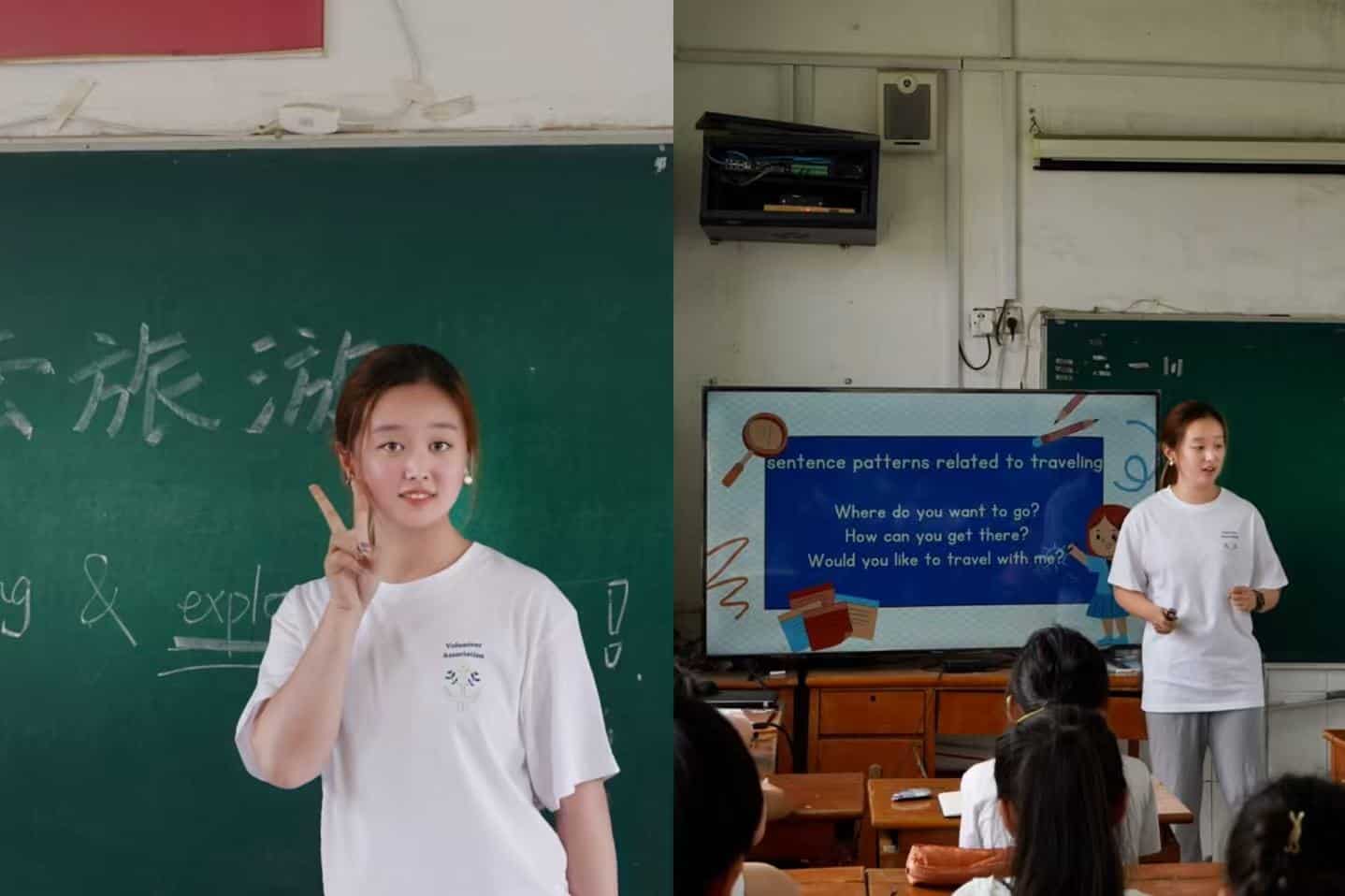
Along the way, she also tutored, volunteered and spent time on the tennis court. Some of those experiences came from curiosity, others from a desire to be useful. Together, they made her college years feel bigger than any one subject.
“There are a lot of opportunities at DKU,” she said. “You don’t have to rush to figure everything out, but when the right opportunity comes, you do have to be ready to take it.”
She did not start college with a fixed plan. What she had was the habit of staying with hard things long enough to understand them, and long enough to see where they might lead. Over time, that helped her find her own direction.
By Chen Chen