
When Aleksandra Stryjska, also known simply as Ola, finally landed in Shanghai on the last day of January 2023, just as China was reopening to international students after years of COVID restrictions, she imagined dragons winding through the streets, red lanterns glowing above steaming food stalls. Instead, she stepped into a city that seemed to be holding its breath
“It was the worst idea possible,” she said with a wry smile, remembering how every shop was shuttered for the Chinese New Year holiday.
No bedding. No SIM card. No bank account. Not even a working heater in her temporary off‑campus apartment.
Hunger drove her to the only place she could find open: McDonald’s. The cashier shook her head at Ola’s foreign credit card. Then the woman reached over the register.
“I see you’re hungry. It’s Chinese New Year. I will pay for you.” The woman’s generosity became Ola’s first experience of Chinese hospitality.
Now graduating from Duke Kunshan University with a major in Molecular Bioscience (track in Biogeochemistry), Ola’s path to DKU was shaped by a series of unexpected turns.

A Polish teen and Asian roommates in a German boarding school
Ola grew up in a small town of roughly 2,000 people tucked against Poland’s western border. Home meant dense forests, where she foraged mushrooms with her parents and watched rivers glint between pines. As a teenager, she enrolled in a German international boarding school, confident she would room with fellow Poles. A random room assignment at the school placed her in the “Asian” dorm, sparking an unexpected love for Asian culture and friendships.
“At first, I was mad because I wanted to live with Polish students,” she said. “I didn’t even speak English at the time. My German was poor, and I was very anxious about it.”
The anxiety didn’t last. Her first roommate was Chinese; her second, Vietnamese. Within months, Ola was trading chopstick lessons for Polish tongue‑twisters and embracing kimchi alongside pierogi. After that year, she was given the option to move to the “Polish” dorm, but she chose to stay in the Asian dorm for the rest of high school. By graduation, most of her closest friends hailed from China, Vietnam, and Korea.
One checkbox, three continents, and a life rewritten
With an “American dream” in mind, Ola applied to UC Berkeley, the University of Toronto and Duke University. Duke’s application included a question asking whether she wanted her file forwarded to Duke Kunshan University. She checked the box. Berkeley offered its academic reputation; Toronto offered a full scholarship. But DKU offered something different: a chance to pursue an American-style education while reconnecting with Asia.
“I had this American dream, but DKU allowed me to fulfill that while also reconnecting with Asia,” Ola said.

COVID delayed Chinese visas, so instead of heading to the East, she continued westward and spent her freshman year at Duke University in the U.S. But as soon as China opened its borders, Ola eagerly made her way to Kunshan.
Major in molecules, heart in the human brain
Officially, Ola will cross DKU’s stage with a B.S. in Molecular Bioscience (Biogeochemistry), one of the most efficient routes for a pre‑med checklist. But her strongest academic interest lies elsewhere: neuroscience. Her summer project with chemist Prof. Floyd Beckford and biologist Prof. Anastasia Tsigkou synthesized metal complexes that could one day fight cancer. Impressive, yes, but it was her Signature Work under Prof. Eric Tam that deepened her interest in neuroscience.

Together they asked a cosmic question: How would the 24‑hour‑39‑minute day on Mars scramble a human brain? Using animal models under “Martian” light cycles, Ola documented shifts in sleep architecture and circadian gene expression.
“Even though the Mars day is only about 0.6 hours longer, it actually impacts biological rhythms,” she said. She now hopes to pursue a Ph.D. in circadian neuroscience, ideally after medical school.
Another key figure in her academic journey was Prof. Pedro Rada, who taught Neuroscience 102, the course that made her decide to continue exploring the brain.
“He was my favorite professor at DKU,” Ola said. “During our first meeting in my sophomore year, he inspired me to make the connection between science and medicine: ‘Do both, just like me.’”
Clubs, cats, and a campus transformed
Outside the classroom, Ola threw herself into campus life. She became president of three clubs: Animal Protection Academy, the volunteer network that feeds, vaccinates, and shelters DKU’s 55 semi-feral cats; Plant Futures Club, which promotes sustainable horticulture in dorm rooms and community plots; and Puzzle Mind Club, which offers late–night jigsaw sessions for mindfulness and stress relief.


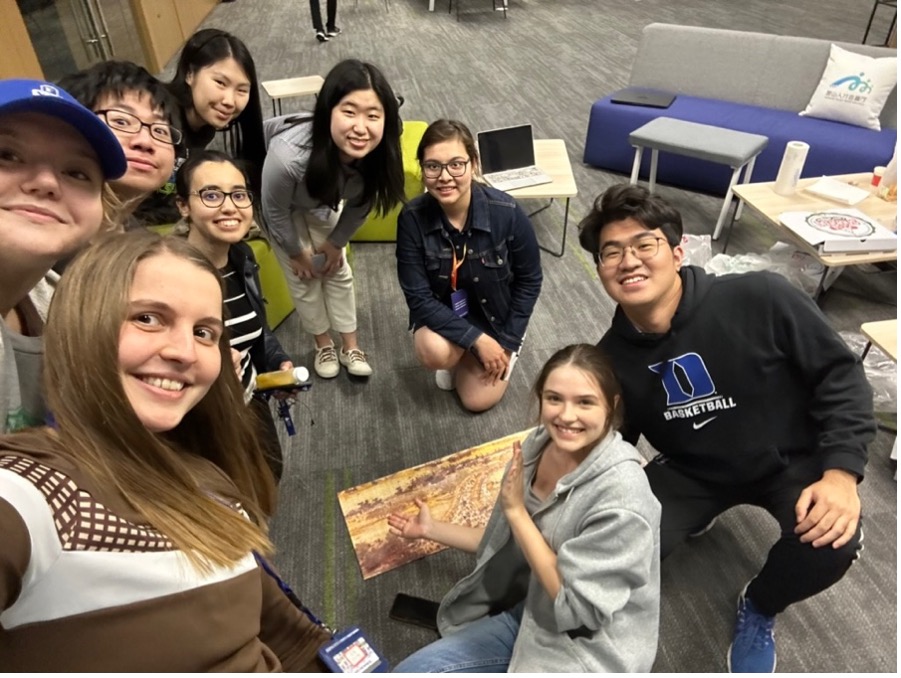

“Our work often went unnoticed,” she said, “but we won a Starbucks Foundation grant of 15,000 RMB, established partnerships with local shelters, and developed protocols for cat care.” One sickly kitten was even airlifted to live with Ola’s parents in Poland.

Ola was initially waitlisted for a Resident Assistant position. She asked Residence Life staff for feedback, reapplied and eventually secured the role. Then at her first floor meeting, she stared at 36 expectant freshmen.
“I was so anxious,” she said. Two hours later, they were playing icebreaker games and planning midnight snack runs. Those freshmen still text her memes and life updates.

Her philosophy: small, personal gestures. She baked birthday cupcakes, slid holiday cards under doors, and hosted one‑on‑one lunches. The approach paid off. She was named Resident Assistant of the Year. Her personal approach made a lasting impact, especially on freshmen who saw her as family rather than just a supervisor.
From ambition to alignment
Adapting to life in China had its hurdles, particularly language barriers and cultural adjustments. Yet Ola quickly noticed intriguing similarities between Chinese and Polish cultures.
“It surprised me how similar they are,” she said, pointing to shared etiquette around gift-giving and friendly battles over restaurant bills.
She also admired the incredible efficiency of life in China, recalling ordering a suitcase online at 1 a.m. that arrived in under half an hour, a feat unimaginable back home.
That spring, Ola received a Ph.D. offer from Cambridge and a Master’s from Oxford. But her priorities had also begun to change. Throughout that journey, her friends helped her hold everything together.
“They stood by me during some of the most difficult moments of my life,” she said.
When a misunderstanding in a group chat triggered one of the most difficult periods she had experienced, a group of them showed up at her door with ice cream.
“I love ice cream. I even run Instagram accounts about it,” she added. Some friends accompanied her to hospitals. “I truly wouldn’t have made it without them.”

Initially career-driven, Ola admits her DKU experience shifted her priorities toward relationships and mental well-being.
“At first, I imagined myself at top universities doing groundbreaking research,” she said. “But gradually, I realized relationships and family matter more than just chasing a career.”

She now seeks balance, choosing to pursue medical school closer to home over prestigious offers from Cambridge and Oxford.
Ola had not always planned to become a doctor. Initially uninterested in becoming a doctor, volunteering at a COVID-19 hospital in 2020 changed everything. Witnessing firsthand the profound impact doctors made on patients’ lives convinced her this was the path she wanted to pursue.
“Seeing the fulfillment doctors had when patients recovered made me realize there’s no other job that would make me feel as fulfilled.”
Medicine, she decided, was her compass science for the sake of human stories.

What Ola’s taking home (besides a cat and five languages)
Soon, Ola will trade Kunshan’s high-speed trains for Poland’s forest trails, where chanterelles hide beneath moss and a once-abandoned kitten naps on her childhood bed. She leaves China fluent in five languages, armed with molecular know‑how, circadian curiosities, and enough cat‑rescue protocols to start a shelter anywhere on Earth or Mars.
If she could start her first year again?
“I would protect my mental health better. In my freshman year, I focused too much on grades and missed out on other important experiences.”
Now she urges new students to learn Chinese early, make time to rest, and remember that sometimes a B can be braver than an A.

By Chen Chen