
Two students from Duke Kunshan’s Class of 2026 have received scholarships to study at the prestigious Yenching Academy of Peking University.
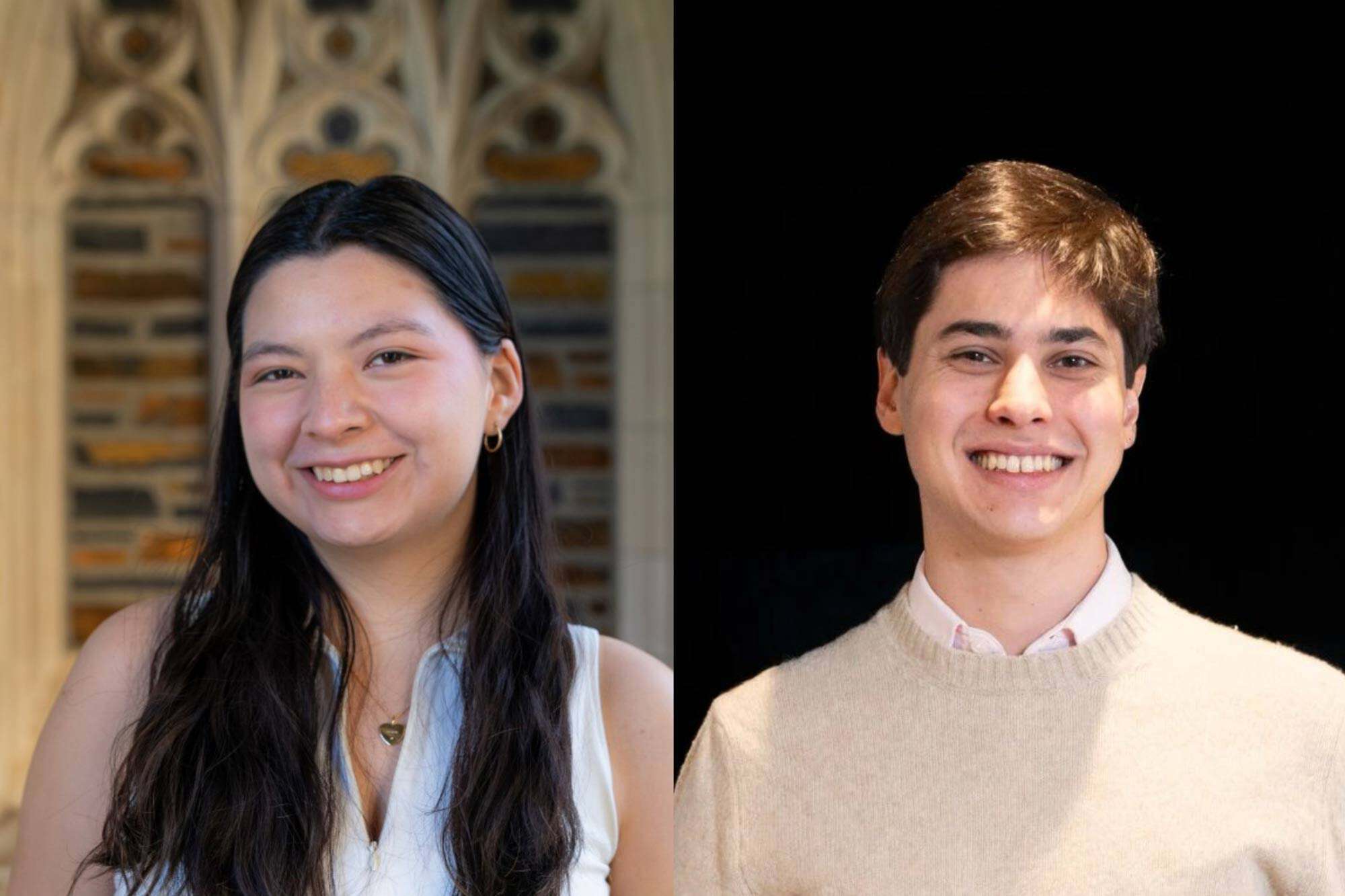
Dalia Guerrero Flores, a global China studies major from Mexico, and Felipe Rebello Silvestri, a political economy major from Brazil, will pursue master’s degrees in China studies, with a concentration in politics and international relations.
Yenching Academy, a selective graduate school at Peking University, brings together young scholars from China and around the world for interdisciplinary study of China. The academy enrolls about 120 students each year.
For Dalia and Felipe, the scholarships are the next step in paths that began in Latin America, deepened in China and took shape through DKU’s interdisciplinary education.

Dalia first learned about DKU during an online university fair in high school. University presentations were organized by country, and the session on China caught her attention. After hearing a DKU presentation, she began researching the university and eventually decided to apply to DKU.
For her family and friends, the decision came as a surprise. Many people from her high school studied abroad, she said, but no one she knew had gone to China.
“It wasn’t real until it was real,” Dalia said. “No one could actually believe it until I was here.”
At DKU, Dalia’s path to global China studies took several turns. She first thought she might study math, then became interested in philosophy. After taking courses in global China studies, Chinese history, philosophy and language, she found herself drawn to the field.
One set of sophomore-year courses was especially important. She was taking Chinese, ancient Chinese history and philosophy, and 20th-century Chinese history at the same time. What she learned in one class helped her understand another.
“I could feel my brain making connections,” Dalia said. “I was gaining a lot of perspective from very different classes and very different areas of knowledge.”
She said DKU gave her a rare way to study China through both liberal arts learning and lived experience.
“You have the interdisciplinary, liberal arts approach, but you still get to be in China and learn from firsthand experience,” she said.
Dalia’s interest in China studies is also connected to Mexico’s development. She said her parents grew up at a time when many people in Mexico saw China as a poor country. Over the decades, that perception changed dramatically as China’s economy and technology gained global prominence.
“For me, the question is: What can Mexico learn from China in order to grow?” she said. “It is not only about economics. It is about the development of the country as a whole.”
Outside the classroom, Dalia traveled widely across China, visiting 24 provinces and about 40 cities. Those travels, she said, deepened her understanding of China’s diversity and strengthened her interest in the country.
A DKU course on China and the Silk Roads helped spark that curiosity. Until then, she said, much of the history she had studied focused on Mexico, the West or modern China.
“It made me realize how much I didn’t know about the world and how limited my history background had been,” she said. “I felt like I was discovering new worlds while I was learning.”
Dalia said her first year at DKU was difficult as she adjusted to a new country, new friends and a new academic environment. Over time, she found her footing.
“If you had told me at the end of freshman year that I could be successful at DKU, I would not have believed it,” she said. “I had a rockier path, but it ended up working out.”
For Dalia, the future may include diplomacy. She said she is interested in working before deciding whether to pursue a doctorate, and one possibility she takes seriously is working for Mexico’s embassy in China.

Felipe’s interest in China also began before DKU, but took clearer shape through his studies, research and campus life in Kunshan.
Born in São Paulo, he spent part of his childhood in Monterrey, Mexico, where he learned Spanish and English. After returning to Brazil at age 11, he studied French before turning to Mandarin in high school.
He said he became interested in China studies through language learning and news about China’s growing importance for Brazil. A freshman-year course in global China studies introduced him to China’s engagement with the world diplomatically, politically and economically. Later, a course on China’s economic transition helped him better understand the relationship between China’s politics and economy.
At Yenching, Felipe hopes to study Chinese investment in Brazil and Latin America, including energy, agriculture, infrastructure, manufacturing and services. He said he wants to understand how China has invested in the region, how that investment is changing and what the next stage of China-Latin America economic ties may look like.
His long-term goal, he said, is “to become the most relevant interpreter of Brazil–China relations — not the person who translates, but the person who can bridge both countries.”
DKU, Felipe said, helped prepare him for that work by allowing him to move across disciplines. His research experience has included political theory, comparative politics and green finance, while his Signature Work project explored questions involving trade, ecology and economics.
His campus life was equally broad. At DKU, Felipe served as president of a Latino student organization, president of the film society, captain of the soccer team and a member of the sports club executive board.
“In all different ways, in all different parts of my life, I was never restricted to only one thing,” he said. “I showed a holistic approach.”
Felipe said students interested in opportunities such as Yenching should use their first years at DKU to take a broad range of China-related courses, identify their interests, build relationships with professors and seek research opportunities.
By junior or senior year, he said, students should be able to show sustained interest in China studies through coursework, research or other serious work in the field.
For Felipe, the next step is both academic and practical. He hopes Yenching will help him become fluent in Chinese, meet scholars from around the world and deepen his understanding of China-Brazil relations.