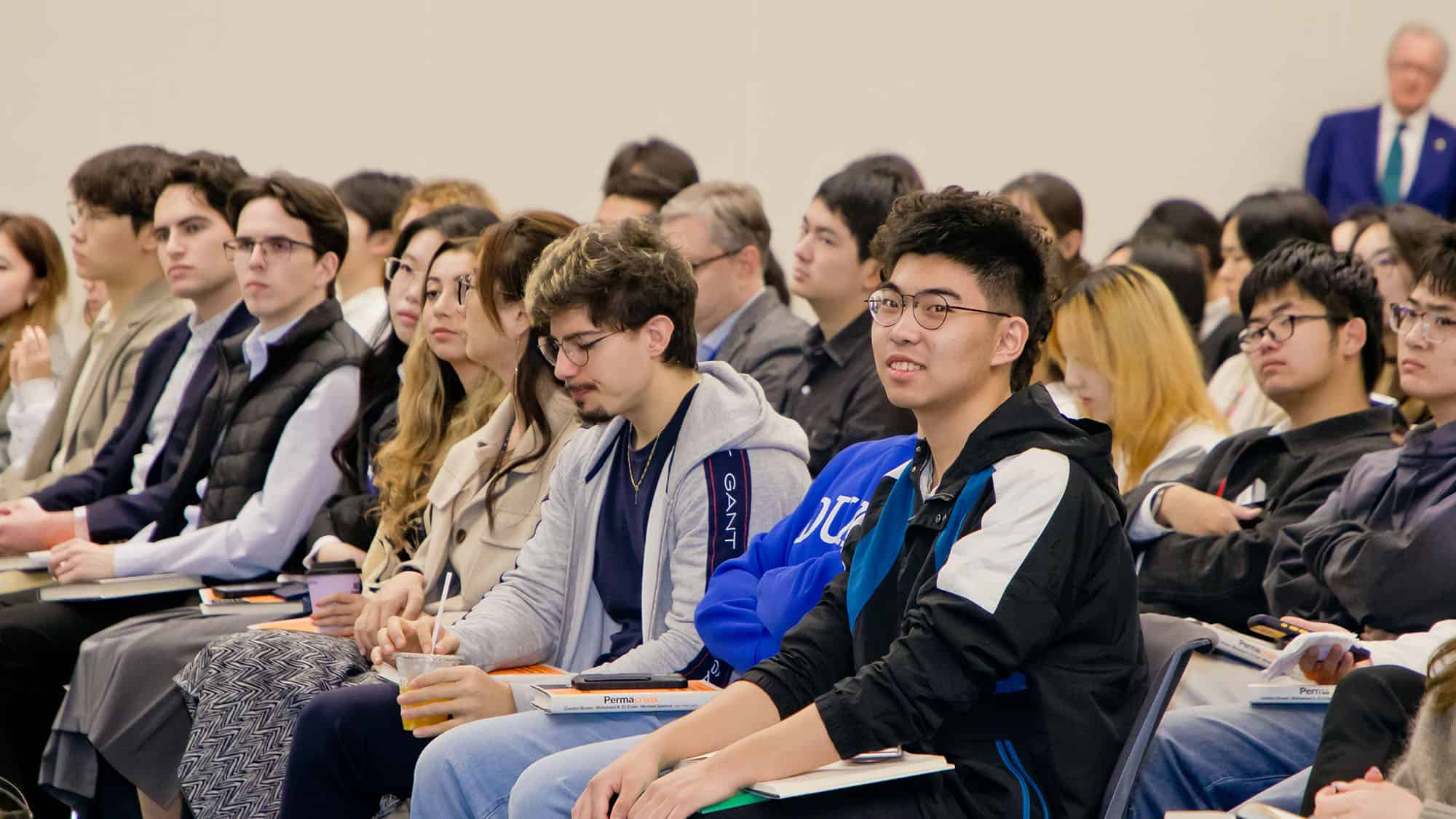
The biggest economic gains from artificial intelligence may come not from the next breakthrough model but from putting the technology to work in hospitals, factories, businesses and government agencies.
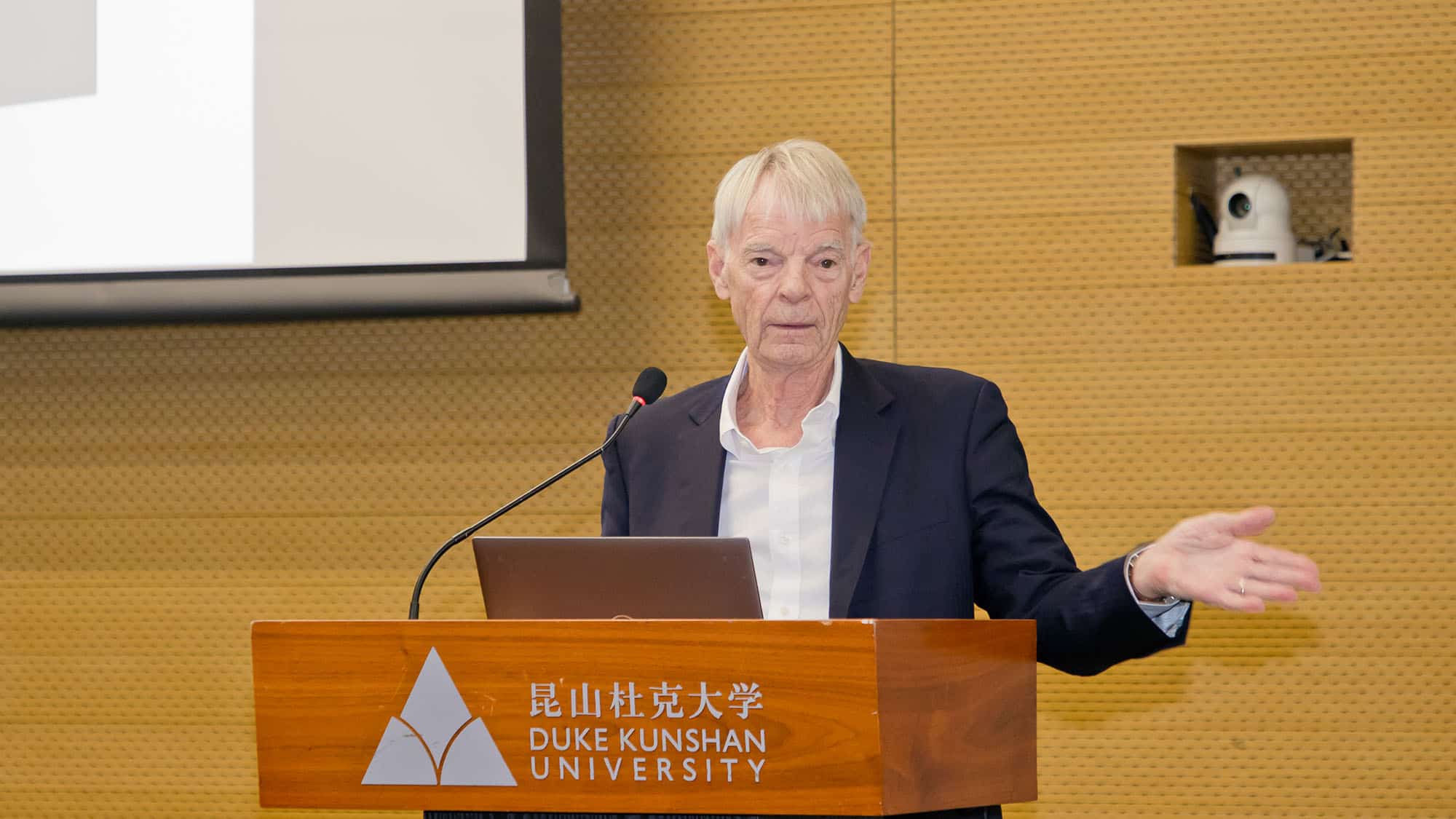
Spence delivers a lecture at DKU.
Nobel Prize-winning economist Michael Spence made that case at Duke Kunshan University on Nov. 16.
As aging populations, geopolitical tensions and rising debt weigh on economic growth, he said, the widespread adoption of AI could provide a much-needed boost.
But realizing that potential, he cautioned, will take years of investment and changes in how organizations work.
Spence, a professor emeritus and former dean of Stanford Graduate School of Business who received the 2001 Nobel Memorial Prize in Economic Sciences, delivered a lecture titled “AI and the Future of the Global Economy” as part of DKU’s Distinguished Speaker Series.
Introducing Spence, DKU Executive Vice Chancellor John Quelch announced plans to bring a Nobel laureate to campus each year, with Spence serving as the inaugural distinguished lecturer on the global economy. Quelch also moderated the question-and-answer session.
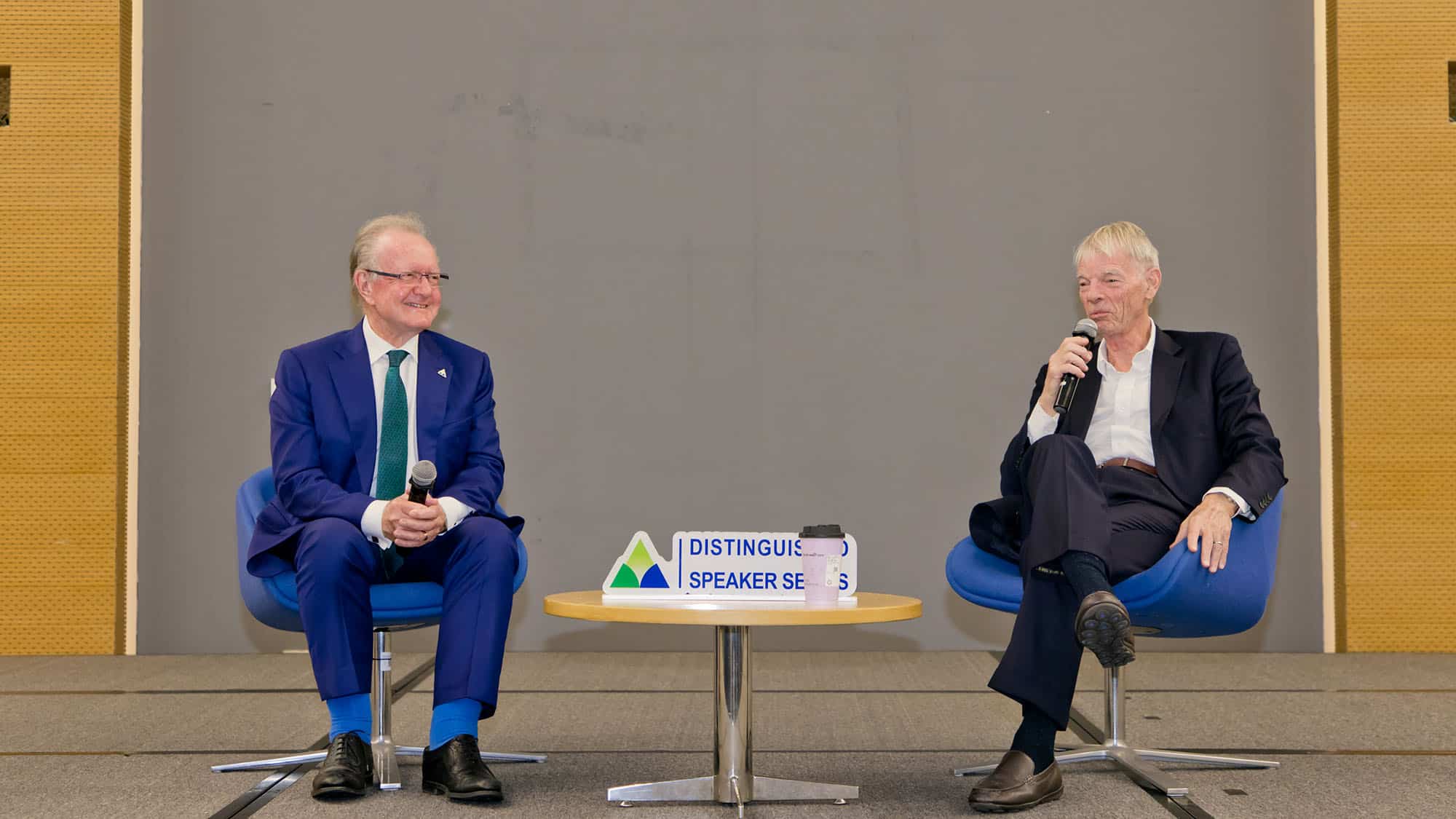
Spence and Quelch during the Q&A session.
From AI breakthroughs to economic growth
Spence outlined four long-term drivers of economic growth: labor, specialization, capital investment and technological innovation.
The first two are under pressure. Aging populations are slowing labor force growth, while geopolitical tensions are driving countries to diversify supply chains, often at the expense of the efficiency that globalization made possible. Rising government debt adds to the strain.
That makes investment and technological innovation increasingly important, Spence argued.
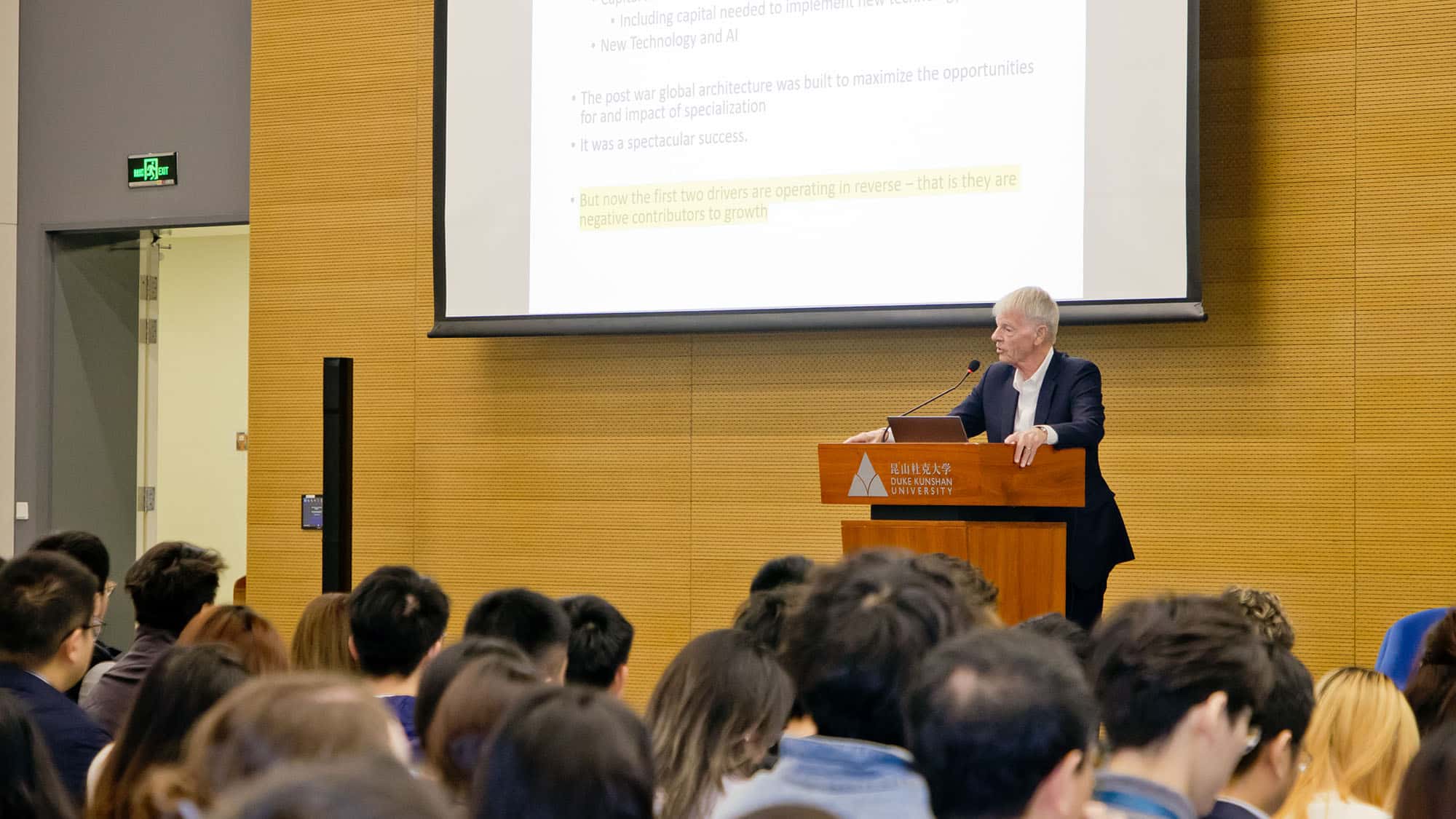
He urged the audience to distinguish between two parts of the AI revolution: developing increasingly powerful models and spreading their use throughout the economy.
The first is an expensive undertaking dominated by the United States and China, whose leading AI systems have become increasingly competitive, he said. Chinese developers have also emphasized lower-cost, open-weight models that others can adapt, potentially accelerating AI adoption in emerging economies.
But the second part, known as AI diffusion, may ultimately matter more.
For AI to deliver substantial gains in economic productivity, it must move beyond technology companies into major employment sectors such as healthcare, construction, retail, hospitality and government.
If those gains are concentrated in only a handful of industries, Spence warned, AI could widen economic inequality rather than spread its benefits across society.
How quickly AI is adopted will help determine not only the pace of economic growth, he said, but also whether enormous investments in AI infrastructure generate sufficient returns.
He described a pattern economists call the “J-curve,” in which organizations initially invest in new technologies without seeing immediate benefits. Productivity gains emerge later, as workers develop new skills and businesses change how they operate.
Spence suggested that AI-driven productivity gains could begin to emerge across the economy over the next five years under favorable conditions. For now, evidence of such gains is more visible in individual industries than in broad economic data.
He was particularly optimistic about AI agents, which can carry out multistep tasks on behalf of users and free professionals from time-consuming work. He also highlighted robotics, which could extend AI’s benefits to work requiring physical skills.
China, he suggested, could become a leader in robotics, partly because its vast manufacturing sector provides opportunities to develop and deploy the technology.
Beyond wealthier economies, AI could also expand access to essential services in underserved communities, making healthcare, education and financial services more accessible to people living far from major population centers.
Opportunity, uncertainty and the future of work
Despite his optimism, Spence warned that the AI boom carries significant financial risks.
Technology companies are investing enormous sums in data centers, advanced chips and other infrastructure. Whether those investments pay off depends on how broadly AI is adopted and whether the resulting revenue justifies the spending.
If adoption falls short of expectations, investors could reassess the value of major technology companies, potentially triggering a sharp market correction. A sufficiently large correction, he warned, could contribute to a U.S. recession with consequences for the global economy.
But Spence distinguished the possibility of an investment bubble from the technology’s long-term potential. Even a substantial market correction would not necessarily derail AI adoption.
During the Q&A, he also challenged the idea that AI’s greatest economic value lies in replacing workers.
“I don’t think the natural use for artificial intelligence is replacing people,” he said.
Instead, he argued, AI should help people save time, solve difficult problems and accomplish things they could not do on their own.
For businesses, the greater long-term opportunity may lie not simply in cutting costs, but in creating new products, improving customer experiences and expanding markets.
Spence was also skeptical of predictions that AI would soon make human work unnecessary.
Asked by Quelch about Elon Musk’s suggestion that work could eventually become optional, Spence said he did not expect such a future within his lifetime.
He cited the engineers at Taiwan Semiconductor Manufacturing Co., who spend years working together to master the complex process of making advanced chips. That collective expertise, he argued, cannot simply be captured in a manual, and he doubted an AI model could readily reproduce it.
The value of a liberal arts education in the AI age
For a university built around liberal arts and interdisciplinary learning, Spence’s remarks also raised a fundamental question: What should students learn when AI can perform an increasing range of intellectual tasks?
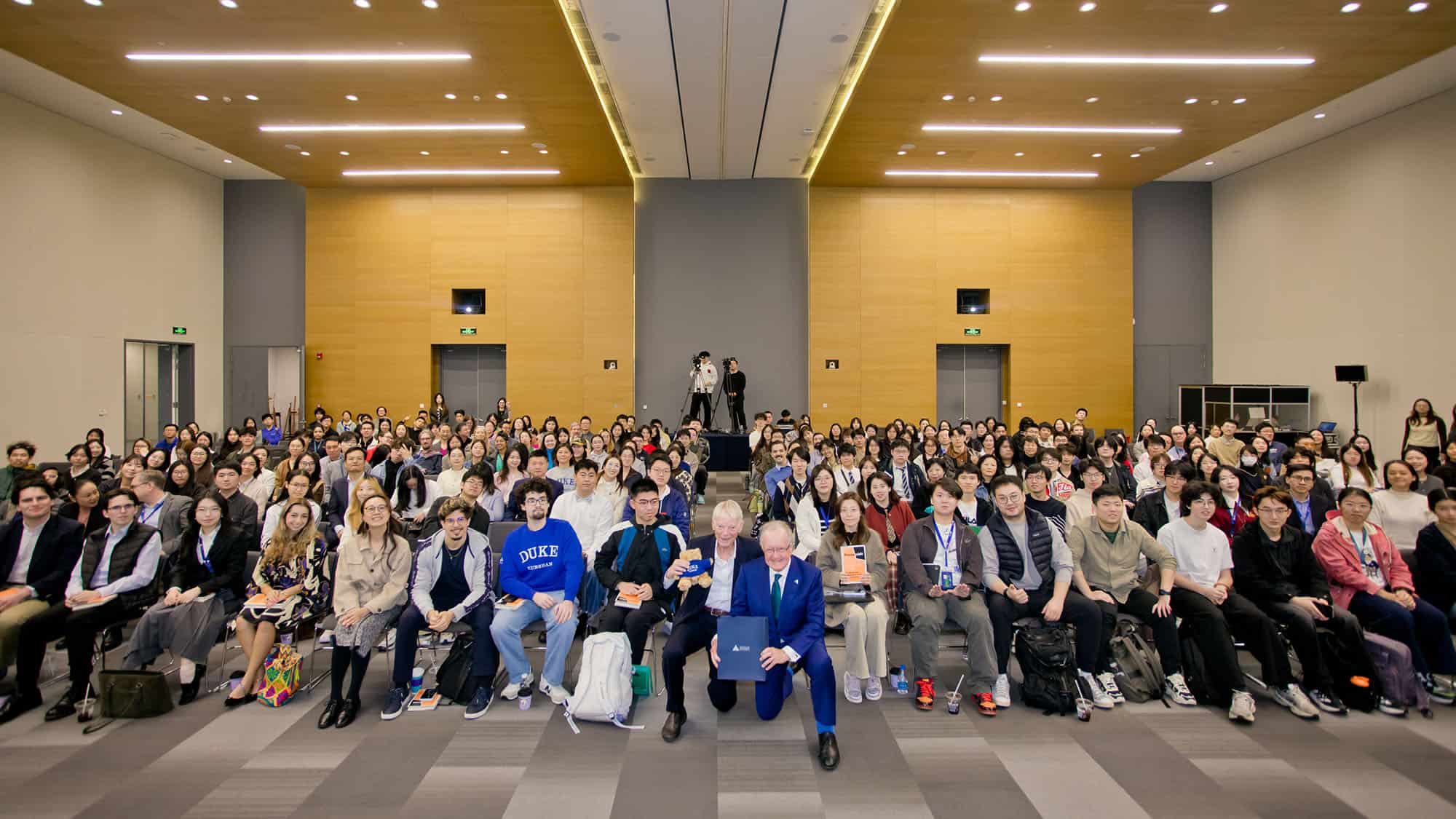
Spence poses for a photo with the DKU audience
Spence’s own academic journey offered an interesting perspective. Before becoming a Nobel Prize-winning economist, he studied philosophy at Princeton University, mathematics at the University of Oxford and economics at Harvard University, an interdisciplinary path Quelch highlighted when introducing him.
Asked how students and faculty should respond to the AI revolution, Spence encouraged them to embrace the technology as a powerful learning tool, regardless of their field of study.
But he drew a clear distinction between using AI to enhance learning and allowing it to replace independent thought.
“Never use it as a substitute for yourself ever,” he said.
He also emphasized transparency in the use of AI for academic work and predicted that universities would need to reconsider traditional assessments, including take-home exams and written assignments, as AI makes it increasingly difficult to distinguish students’ own work from AI-generated content.
In one of the session’s final exchanges, a DKU student asked whether degrees from good universities might become even more valuable as AI makes it harder for employers to assess applicants’ genuine abilities.
Spence agreed. The question was particularly fitting for an economist whose Nobel Prize-winning research helped explain how educational credentials can signal an individual’s abilities to potential employers.
But the value of higher education, Spence suggested, extends well beyond acquiring knowledge or technical skills.
He said universities must also develop people with vision, motivation and the ability to work together to accomplish more than they could individually.