
A new study led by Professor Binbin Li’s research team at Duke Kunshan University (DKU) examined how the expansion of solar and wind energy sites under different levels of centralized planning may lead to different biodiversity outcomes in China.
The findings, published in Nature Ecology & Evolution, provide a transferable framework for countries and regions seeking to assess renewable energy siting across planning scales and better align energy development with biodiversity conservation.
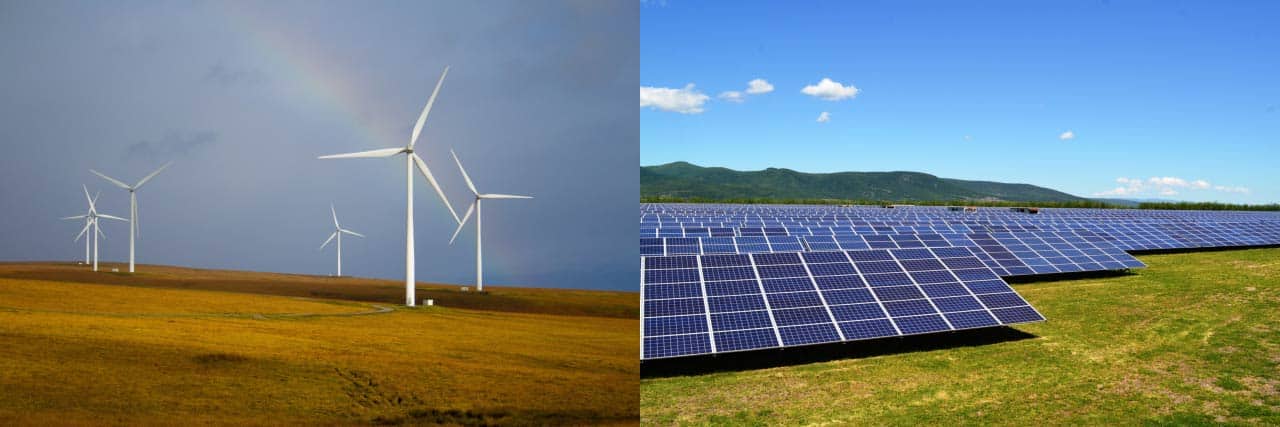
Image source: Pixabay
Renewable energy development is essential for reducing greenhouse gas emissions and meeting climate goals. Yet the construction and operation of large-scale facilities could pose potential threats to ecosystems and species habitats. This creates a planning challenge: how can countries expand renewable energy siting while minimizing potential conflicts with biodiversity conservation?
“A sustainable energy transition is not only about how much renewable energy infrastructure we build, but also where we build it,” said Binbin Li, senior author of this study and head of the Biodiversity and Sustainability Lab at DKU. “We wanted to understand whether siting decisions made at different planning levels could lead to better biodiversity outcomes.”
Li is an associate professor of environmental science at DKU and has a secondary appointment in the Nicholas School of the Environment at Duke University.
Siting decisions depend not only on environmental or economic resources but also on governance systems. In more centralized systems, national authorities often set targets and guide project placement, whereas local or regional institutions can play a larger role in more decentralized systems. Recent work has increasingly explored how renewable energy projects can be sited to reduce biodiversity impacts, but how planning at different administrative levels shapes those outcomes remains less clear.
The team examined this question in China, where world-leading renewable energy growth is unfolding across a landscape of exceptional biodiversity. Using China’s 2060 carbon neutrality goal as the target, they simulated future expansion of terrestrial solar and wind sites at different centralization scales.
“We designed two siting scenarios to represent different levels of centralization,” said Zhijie Zhou, co-first author of the paper and iMEP’23 graduate at Duke Kunshan University. “In one scenario, we selected optimal sites across the country. In the other, we selected sites within each province based on its existing share of installed capacity.”
By overlaying these projected sites with various terrestrial biodiversity metrics, the authors compared how the two scenarios differed in their potential biodiversity conflicts.
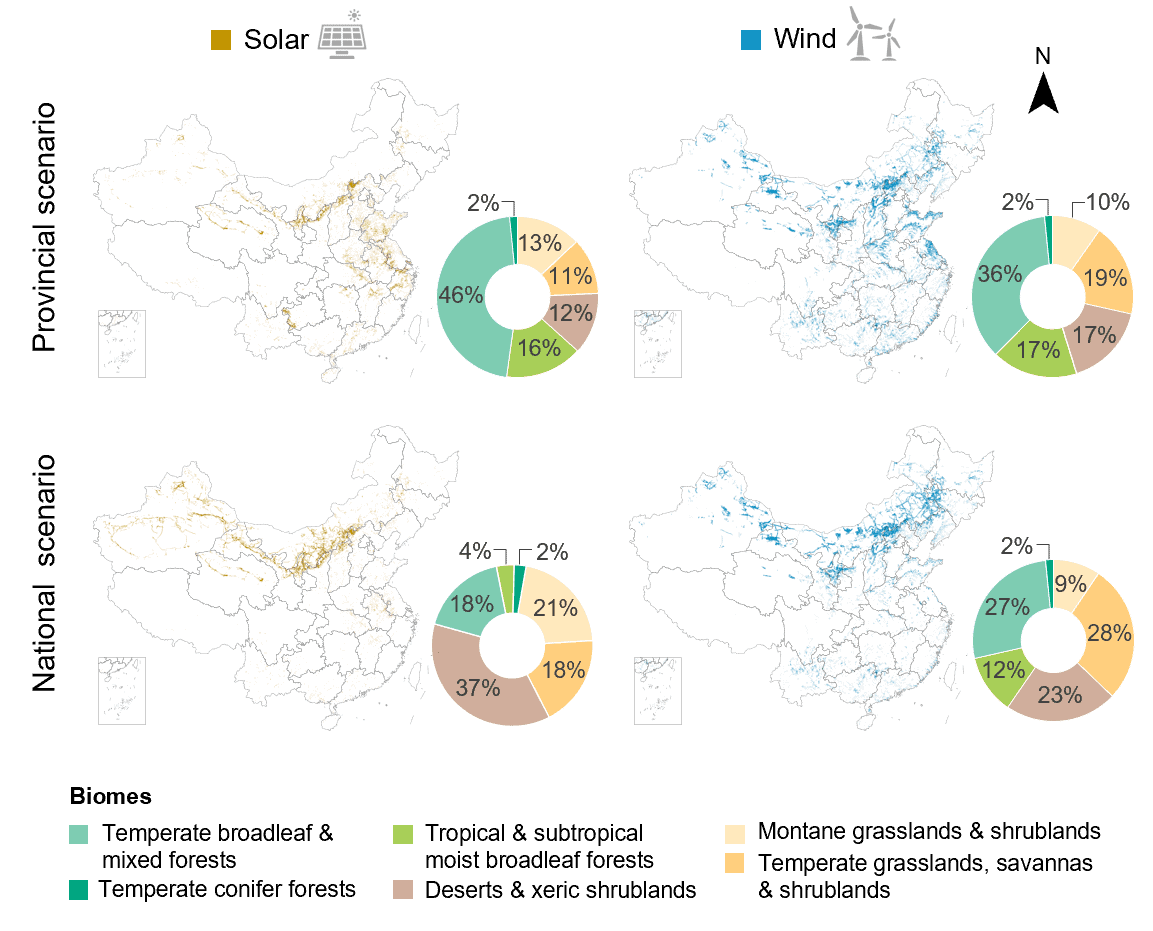
Distribution of projected solar and wind energy sites under the provincial scenario (top row) and national scenario (bottom row), and their overlap with major biomes.
The results showed that compared to provincial planning, sites projected under the centralized national scenario had lower overlap with species-rich conservation priority areas and involved fewer vertebrate species. But this also came with trade-offs. These sites had greater overlap with areas of high functional diversity, and a larger share was located in ecosystems such as grasslands and deserts, where they showed higher potential conflict with habitats of threatened species that depend on these environments. Provincial siting scenarios showed the opposite pattern, with lower overlap with open, arid ecosystems but higher overlap with habitats of forest species, including many small-ranged amphibians.
“This was not a simple case where one planning scale was better than the other,” said Suri Siyu Sun, co-first author of the paper, a research assistant in Li’s lab and a Master of Environmental Management graduate of Nicholas School of the Environment of Duke University. “National and provincial planning each performed better for some aspects of biodiversity while posing conflicts for others, which creates different advantages and trade-offs across indicators, ecosystems, and species.”
The analysis also found limited opportunities for biodiversity-energy synergies. Projected renewable energy sites generally had lower overlap with low-biodiversity synergy areas, suggesting that straightforward win-wins may be relatively limited. Still, national-level siting showed slightly higher overlap with synergy areas than provincial siting, pointing to possible benefits of broader coordination.
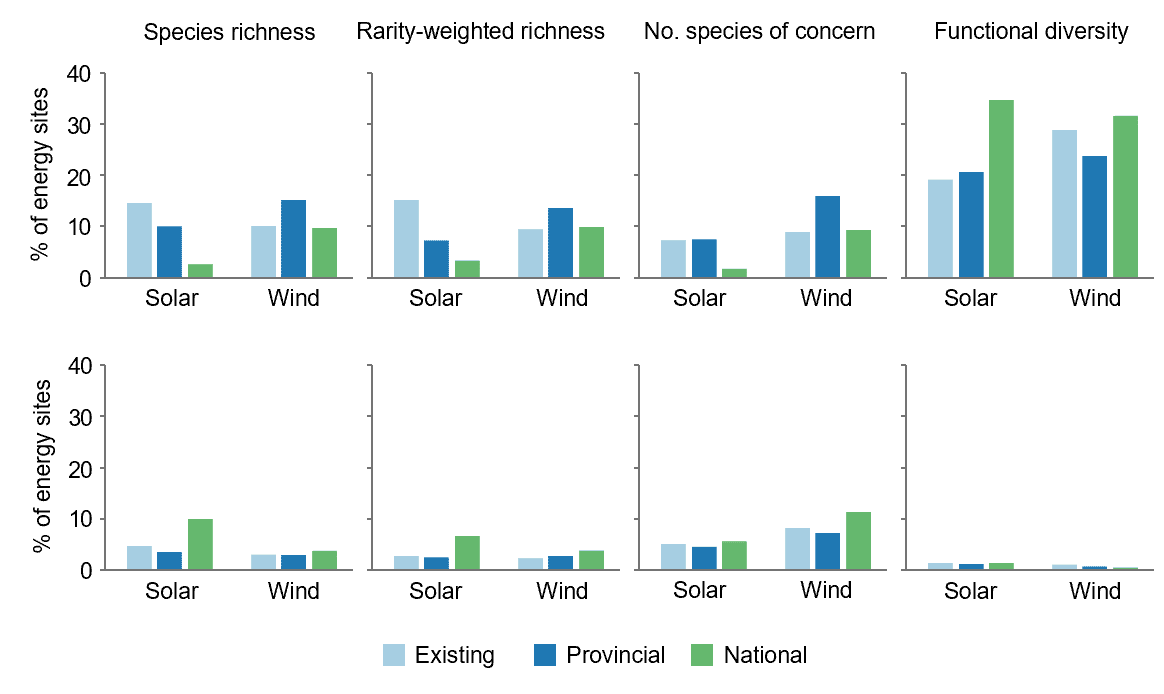
Proportional overlap of provincial (dark blue), national (green), and existing energy sites (light blue) with high-biodiversity conservation priority areas (top) and low-biodiversity synergy areas (bottom).
As the two approaches also differ in cost, technical feasibility, and practical implementation capacity, no single planning scale may fully balance biodiversity conservation with renewable energy expansion. “Our findings point to the need for coordinated, multi-level planning,” said Li. “National planning can help identify broad areas where renewable energy development is more compatible with biodiversity conservation, while provincial planning can bring in finer-scale ecological information to guide more precise siting.”
Meanwhile, the findings also underscore the importance of looking beyond any single biodiversity metric. Assessments that integrate multiple indicators, taxonomic groups and ecological dimensions can better capture different types of conflicts under alternative planning pathways.
Together, a coordinated multi-level planning approach and the use of integrated, multi-dimensional biodiversity assessments will be essential for guiding renewable energy expansion toward a more sustainable balance between climate goals and biodiversity conservation.
