

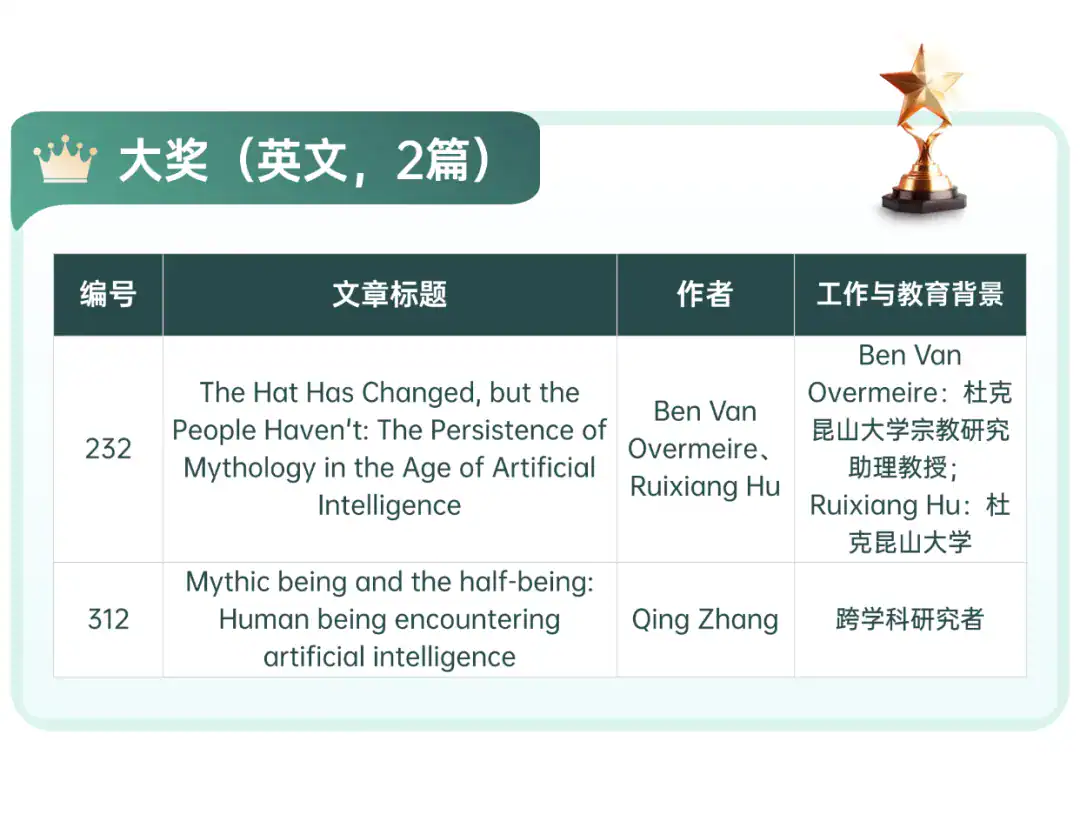
An essay co-authored by a Duke Kunshan University professor and student has won a Grand Prize in the English-language category of the first Fangtang Global AI-Human Collaboration Essay Competition, the organizer, Fangtang Institute at Tsinghua University, announced Sept. 29.
Ben Van Overmeire, assistant professor of religious studies, and Ruixiang Hu, who majors in global cultural studies at DKU, received the award for their essay, “The Hat Has Changed, but the People Haven’t: The Persistence of Mythology in the Age of Artificial Intelligence.” The essay explores whether myths will disappear with the rise of artificial intelligence, arguing instead that AI is creating fertile ground for new myths to emerge.
“What surprised me the most was realizing that myths around AI have long been taking shape in real time,” Hu said. “AI mythology is already being lived.”
The inaugural competition drew 373 eligible entries from more than 500 participants, ranging from high school students and professional scholars to industry practitioners and retirees. After four rounds of anonymous review, 57 entries were shortlisted. Three Chinese-language essays and two English-language essays ultimately received the Grand Prize, while eight others received the Aha Award.
For their winning essay, Van Overmeire and Hu used seven AI platforms for tasks ranging from surveying sources and shaping prose to challenging their reasoning, according to Hu. They tested questions across platforms and brought different responses into conversation, asking the AI systems to question and refine one another’s suggestions.
They also built a multi-agent system that turned Van Overmeire’s digital library of scholarly works into what he described as a “conversation partner.” Some agents searched the library for relevant academic references, while others were modeled on the published works of established scholars. The pair then brought these AI scholar agents together in a virtual “roundtable” to discuss and critique their work in progress.
“The feedback we got was generally useful, both in thinking of ways to further develop the paper and in exposing the limitations of what we were doing,” Van Overmeire said.
But the project was as much about human collaboration as it was about working with AI. Presenting their work together online and at academic conferences also helped the pair refine their ideas, Van Overmeire said.
“For good collaboration, asynchronous online work with occasional meetings is not enough,” he said. “Some of our most important work was done during what we called ‘hackathons’: sitting together in my office for hours cracking problems together.”