
Julia Strick, Duke Kunshan University Class of 2026 graduate, received the Armando Vega Prize for best undergraduate poster at the 2026 International BMAA Conference, held July 30-31 in Salt Lake City, Utah.
Strick was joined by Renee Richer, associate professor of biology at DKU, Class of 2027 student Yuchen Cao and Class of 2026 graduate Yuxuan Huang, in presenting research on BMAA and related compounds.
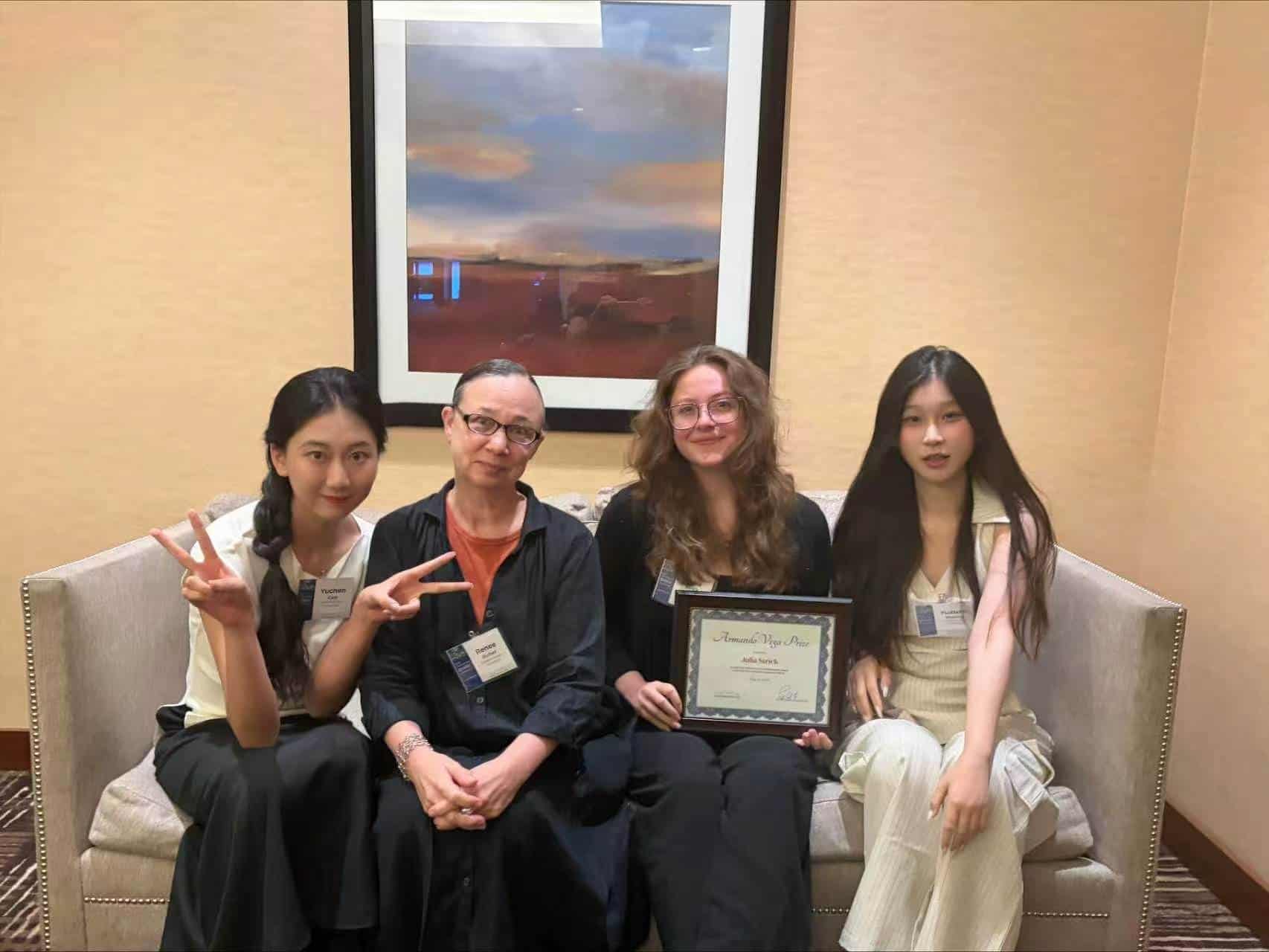
From left: Yuchen Cao, Renee Richer, Julia Strick and Yuxuan Huang.
BMAA, short for beta-N-methylamino-L-alanine, is a naturally occurring compound found in some cyanobacteria, commonly known as blue-green algae. Researchers are investigating its effects on the nervous system and its possible role in neurodegenerative diseases, although a causal link in humans has not been established.
Strick and Huang presented their Signature Work projects, major research or creative projects that DKU undergraduates complete under faculty mentorship. Together with Cao’s research, their projects were part of a collaboration between DKU and Duke University involving Eric Spana of Duke.
Strick’s award-winning project examined how injecting BMAA and alanine into fruit fly embryos affected their later movement. Huang investigated how BMAA affects mitochondria, the energy-producing structures inside cells, and movement in fruit flies.
Cao investigated how BMAA exposure affected fruit flies’ ability to climb and survive, and whether L-serine, a naturally occurring amino acid, could reduce its harmful effects. Her experiments found that BMAA impaired climbing ability and reduced survival in both male and female flies, with males more severely affected. Treatment with L-serine partially reduced these effects.
In a second project, Cao studied how DAB, a compound related to BMAA, affects feeding behavior in Trichoplax adhaerens, a simple marine animal. The study, co-authored with Richer and DKU senior Ming Yuan, found that DAB altered the animal’s feeding behavior depending on its concentration. At one tested concentration, it induced feeding-like cycles, while higher concentrations were increasingly toxic.
Because the concentrations used in the experiments were higher than those typically found in the environment, the researchers cautioned that further studies are needed to understand DAB’s effects under natural conditions.
Richer also chaired the conference’s opening session on environmental exposures and neurotoxins. In a presentation titled “BMAA and Its Isomers in Lake Taihu, China,” she highlighted research on cyanotoxins and microbial communities in the lake, as well as the potential role of vegetation along riverbanks in removing these toxins.