
A faculty-student research team at Duke Kunshan University (DKU) and Duke University has published a policy commentary in “The Lancet Planetary Health” examining the often-overlooked links between climate change and antimicrobial resistance, two escalating global public health threats.
The commentary, titled “Bridging the policy gap between climate change and antimicrobial resistance,” argues that climate factors remain largely absent from existing antimicrobial resistance policies despite growing scientific evidence that warming temperatures and extreme weather events accelerate the spread of drug-resistant bacteria.
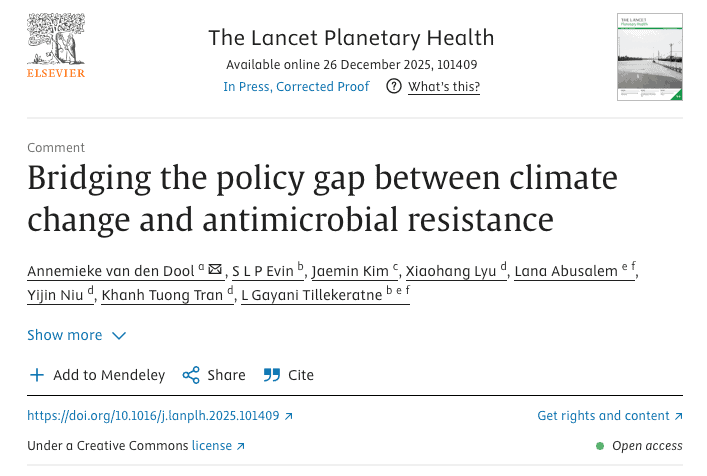
The work was led by Annemieke van den Dool, assistant professor of environmental policy at DKU, and Gayani Tillekeratne, associate professor of medicine and associate research professor of global health at Duke University. It was co-authored by DKU undergraduates Xiaohang Lyv, Yijin Niu, and Khanh Tuong Tran, along with SLP Evin at the Duke-Ruhuna Collaborative Research Centre in Sri Lanka, mathematics student Jaemin Kim at Duke University, and Infectious Disease and Global Health Fellow Lana Abusalem at Duke University Hospital.
The research was conducted through Duke University’s Bass Connections program, an interdisciplinary initiative that brings together faculty and students to address complex societal challenges. The team drew on expertise from global health, medicine, public policy, environmental science and biology.
“Antimicrobial resistance occurs when germs — like bacteria, viruses, fungi or parasites — stop responding to medicines that used to kill them or stop their growth, such as antibiotics,” van den Dool said. “Because this problem has several different causes, it requires an interdisciplinary approach, which is exactly the strength of both DKU and Duke University Bass Connections.”
Antimicrobial resistance, or AMR, is already a major global health burden. An estimated 4.95 million deaths worldwide in 2021 were associated with drug-resistant infections, including more than 1 million deaths directly attributed to AMR. Climate change is expected to worsen the problem by accelerating bacterial growth, facilitating the spread of resistance genes and increasing antibiotic use following extreme weather events such as floods and heat waves.
Despite mounting evidence linking climate change and antimicrobial resistance, climate considerations remain insufficiently addressed in most national and international AMR action plans, the authors wrote.
The team aligned its policy recommendations with six strategic objectives under the World Health Organization’s forthcoming revised Global Action Plan on AMR. The proposals include integrating climate data into AMR surveillance systems, developing predictive models for resistance surges after extreme weather events, strengthening infection prevention and antibiotic stewardship in climate-vulnerable settings, increasing investment in climate-resilient infrastructure and interdisciplinary research, and aligning AMR governance with climate adaptation strategies through stronger accountability mechanisms.
The commentary calls for a “One Health” approach that recognizes the interconnectedness of human, animal and environmental health and urges closer coordination across sectors and disciplines.
The DKU undergraduate researchers said the project provided hands-on experience in applying academic training to real-world policy challenges. Lyv focused on synthesizing scientific literature and identifying evidence gaps from a public policy perspective, Tran analyzed and compared regional AMR policies across countries, and Niu examined how flooding and other extreme weather events influence the spread of drug-resistant bacteria through wastewater overflow, water pollution and changes in community antibiotic use.

“I also find the interdisciplinary and international aspects of this project fascinating and fun,” said Gayani Tillekeratne. “Our research team has generated robust evidence on AMR in South Asia and the U.S., but we have not delved much into policy, which is very important in effecting change. This Bass Connections project has allowed our team to meld the basic sciences, medicine and health, climate science, and policy.”
