
After nine years of teaching, Andrew Cheon finally stopped feeling like he had to perform.
Before coming to Duke Kunshan University, he had spent years lecturing in the United States, often in large graduate-level classrooms and live Zoom sessions where he felt pressure to project authority, always carrying that bit of tension.
“For every lecture, I’d get a bit nervous, like butterflies in my stomach,” he said. “And I did that for nine years.”
At DKU, that feeling disappeared.
“After working with DKU students, I really found myself in the classroom,” said Cheon, associate professor of international relations and the winner of the 2025 DKU Undergraduate Teaching Award. “Now I don’t need to put on an act; I can just be myself.”
From Duke to DKU
Cheon was born in South Korea and moved to Canada at age 10. He grew up in Coquitlam, a suburb near Vancouver, then went to Duke University for his college degree. He later earned both his master’s and Ph.D. at Columbia University and spent nine years teaching in the U.S. before moving to Kunshan, China.
His ties to Duke go back well beyond his current position. As an undergraduate at Duke, he founded Duke East Asia Nexus (DEAN), a student organization and an online academic journal focused on East Asia.
Part of the idea came from seeing similar efforts at other universities. Part of it, he said, was personal.
“I wanted to find new friends on campus and friends who had interest in East Asian issues.”
The group started small. He and his classmates handed out flyers, brought together students with similar interests and encouraged peers to submit East Asia-related papers they had already produced in class.
Over time, the organization took on a life beyond him. Later students continued the organization. Linda Zhang would oversee DEAN’s first print publication, and Jack Zhang went on to help found the Duke-UNC China Leadership Summit. All three are now university professors. Cheon said he had “no hand” in creating the summit, but he still sees the connection as part of the organization’s legacy.
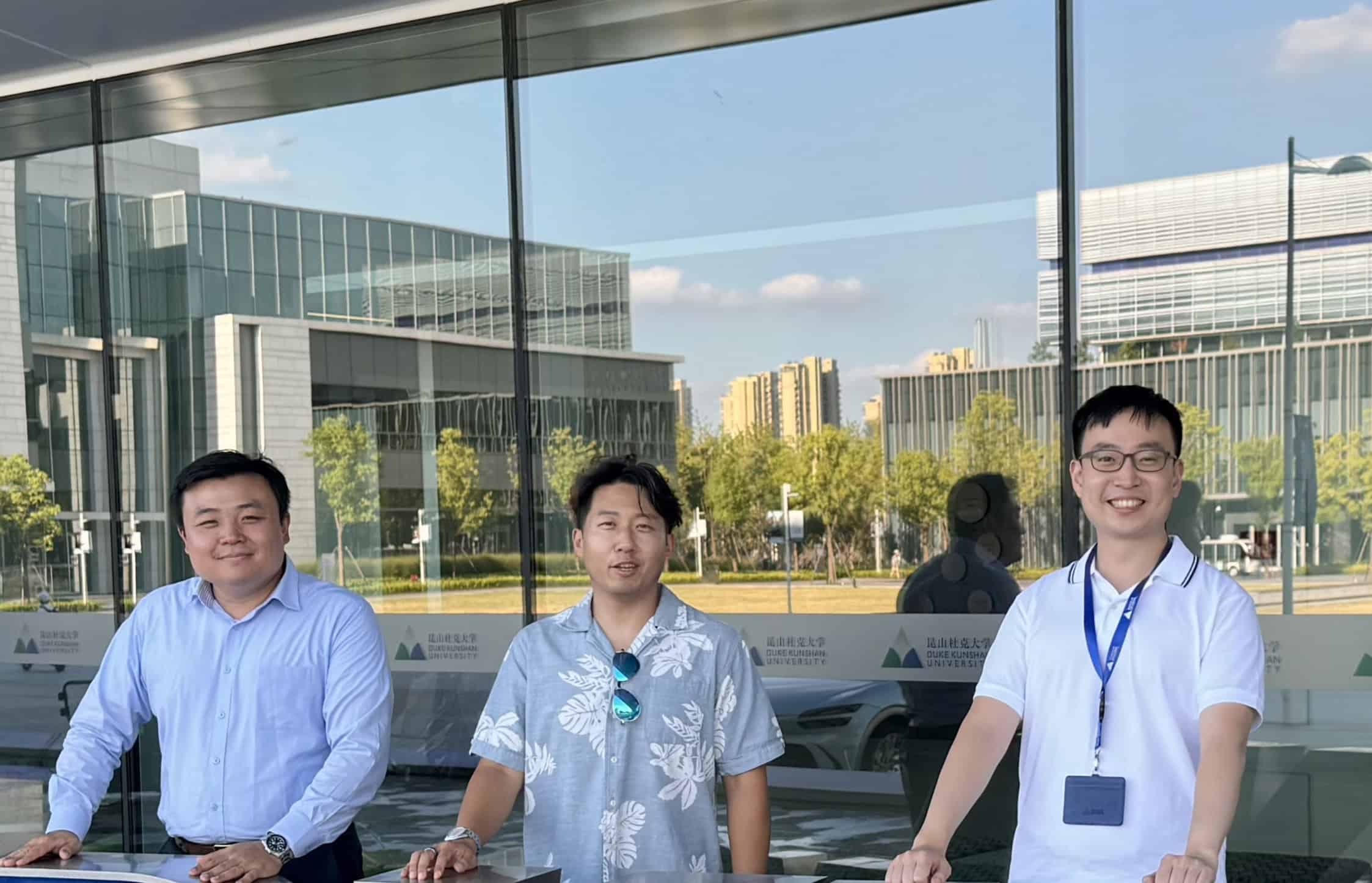
Andrew Cheon, at right, with former DEAN editors-in-chief Jack Zhang and Muyan Jin during their visit to DKU
Another Duke influence proved just as important. As an undergraduate, Cheon had expected to go to law school until Joseph Grieco, an emeritus professor of political science at Duke, encouraged him to consider graduate study in political science instead. Grieco has been a consistent role model and a mentor, checking in on Cheon’s progress throughout his academic journey and meeting with him at conferences.
“Without him, I don’t think I would have been an academic,” Cheon said.
Together, those Duke experiences helped shape both his academic path and his interest in East Asia. Years later, DKU brought those threads together: the Duke community, Asia and the exchange of ideas across borders.
His connection to Duke only deepened after graduation. He joked that he attended more Duke basketball games as an alumnus than he had as a student, when he had been too focused on grades. Over time, he said, he came to appreciate more fully what it meant to belong to the Duke community.
“So when I had a chance to work for Duke, I had to take it. It’s like a dream job,” he said.
But DKU appealed to him for more than the Duke name. It also felt like the right place for the questions that had come to define his academic life.
Cheon studies international relations, with research interests that include energy security, climate politics, state-owned enterprises and great power competition.
His earlier work examined domestic politics and overseas investment by state-owned energy firms. That research became his book, “Fueling State Capitalism,” published by Oxford University Press in 2023.
More recently, his work has focused on industrial policy and U.S.-China competition, especially how countries respond to one another’s efforts to build an advantage in areas with both civilian and military uses.
“I think when it comes to great power competition, the two most important great powers are China and the United States,” he said. “I could not think of a more exciting place to study the subject.”
Teaching without the mask
That sense of relevance carries into the classroom. At DKU, Cheon teaches both introductory and advanced courses. He said students in upper-level classes often arrive ready to discuss, question and build on one another’s ideas. In entry-level classes, he works harder to create that same kind of exchange, sometimes using techniques like “think, pair and share” to help quieter students join the conversation.
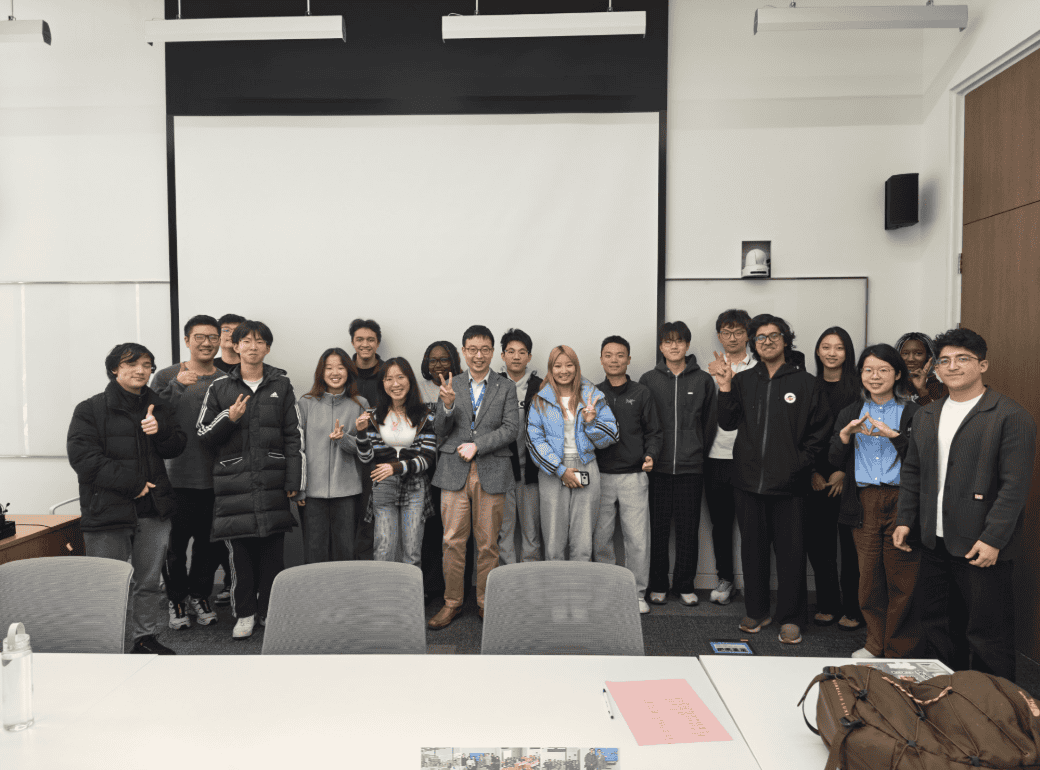
Andrew Cheon with students in his POLSCI 101 class
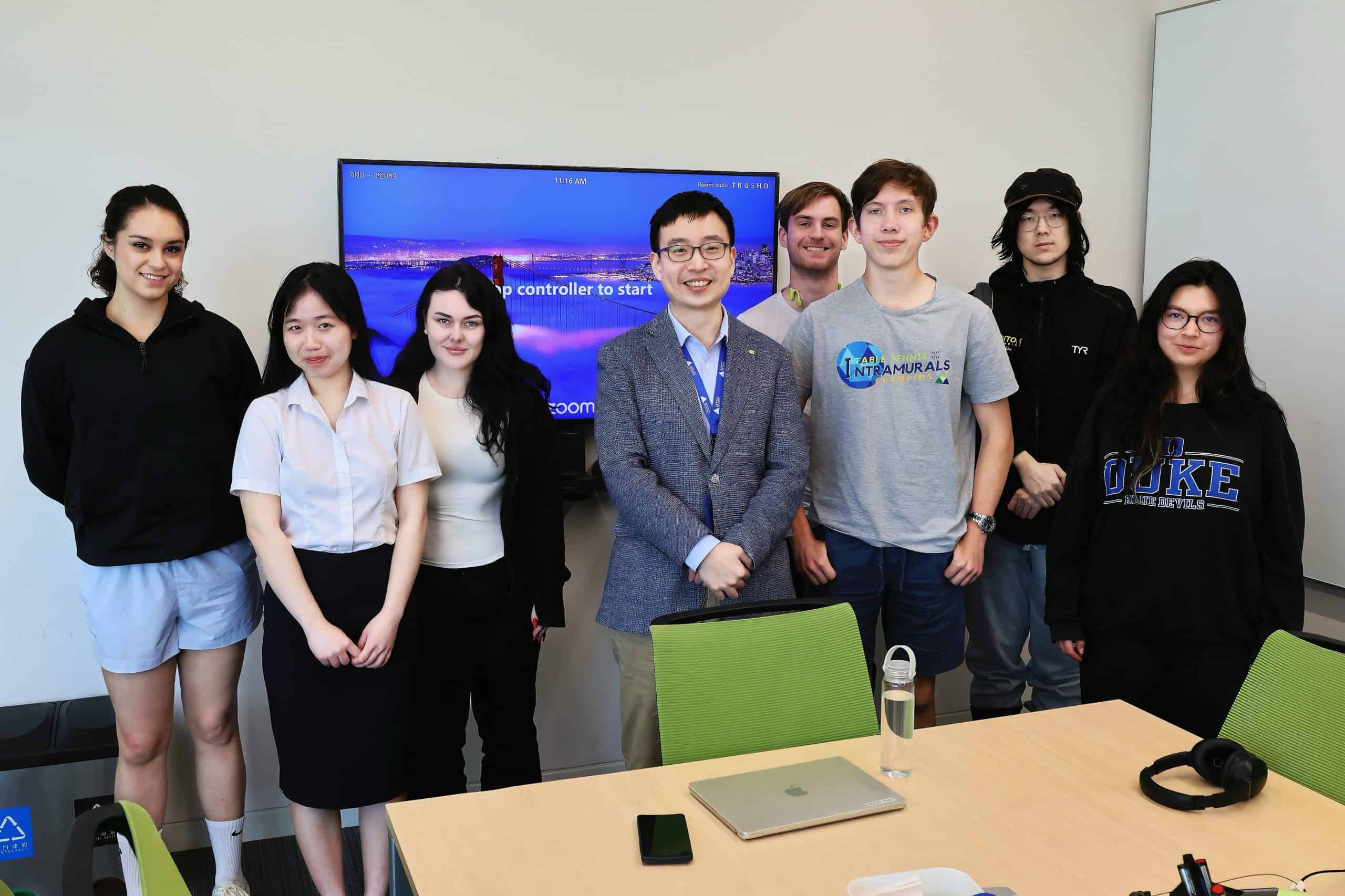
Andrew Cheon with students from his POLSCI 303 class
Still, when he talks about teaching at DKU, he keeps coming back to the students themselves.
“The students, they’re magnificent,” he said. “I love my students.”
He describes them as ambitious, serious and fully engaged. In his view, they do not aim to do just enough to get by.
“They are not satisfied with just doing so-so work,” he said. “They want to excel.”
Cheon said students helped him understand DKU’s classroom culture from the beginning. One of the first was Javier Sebastián Portilla, Class of 2025, whom he met during faculty orientation and later taught in two classes. Javier, he said, gave him real-time feedback on how his teaching was landing and helped him adjust as he settled into the DKU classroom.
Another was Yuwen Zhou, one of his first students at DKU, who helped him think through how to support students from different language and cultural backgrounds in a mixed classroom.
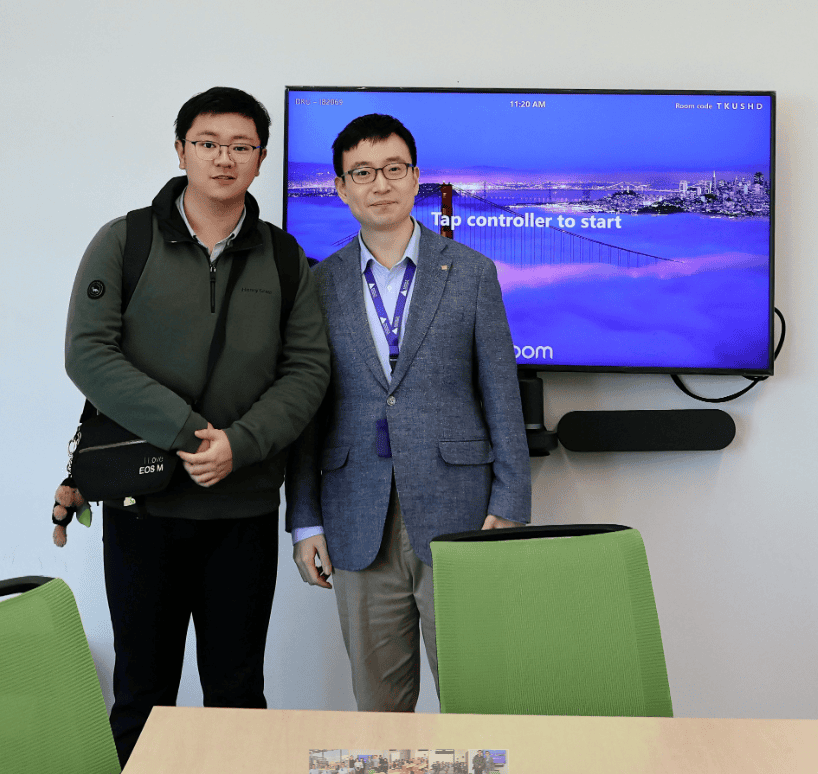
Andrew Cheon with student Yuwen Zhou
“All the teaching tips that I got, besides DKU’s Center for Teaching and Learning, which has been enormously helpful, came from the students,” Cheon said. “I was there to listen and soak it all in.”
That may be the clearest explanation for why teaching at DKU has felt so different from his earlier experience. He did not arrive with a finished teaching style and simply apply it to a new campus. In important ways, he said, students taught him how to teach here.
That connection with students is also carrying into his research. Cheon said he is preparing to work with students through the Summer Research Scholars program on a project examining China’s sovereign wealth fund, a topic that builds on his earlier research on state capitalism and foreign investment. The project, he said, grew in part from conversations with Yuwen Zhou.
Before coming to Kunshan, Cheon mostly taught graduate students in a professional school setting in the U.S. The introductory courses he taught there were typically larger, sometimes 40 students and sometimes 60. The atmosphere, he said, was different, as graduate students at a professional school are not looking for a repeat of their college experience. In that setting, he felt pressure to perform a certain version of what a professor was supposed to be.
“I always felt like I needed to put on a mask,” he said.
He worried about appearance, professionalism and “gravitas.” Around Halloween, a student saw him in an elevator, mistook him for a student and asked whether his jacket was part of a costume. Cheon tells the story lightly, but the moment says something real about that period of his life: He was always aware of how he was being seen, and not always at ease with it.
At DKU, the opposite happened.
Now, he likes living on campus. He likes being able to “just hop on over and talk to my students.” “It just feels so natural,” he said.
The difference, he said, is not only that DKU classes are smaller, though that matters. It is that the classroom feels more personal. In his previous teaching experience, he often faced large groups of older, career-focused graduate students and felt the onus was on him to provide insights with practical implications.
At DKU, he found undergraduate students still early in their intellectual journey and more open to exploring new ideas wherever they might lead. He could learn students’ names, follow their progress and build the kind of trust that makes teaching feel not like a performance, but a conversation.
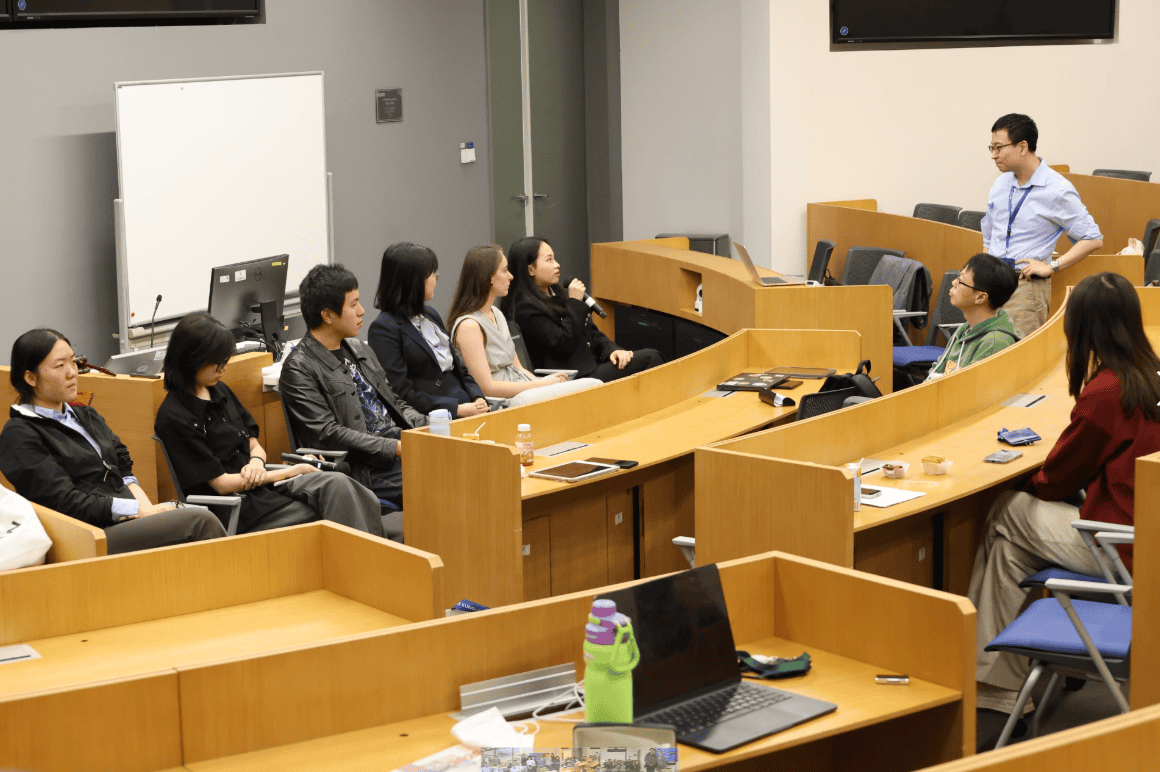
Andrew Cheon listens to a student during a Signature Work panel at DKU
That setting has allowed him to teach the way he had long desired to teach: not as a distant lecturer speaking to an audience, but as someone more like a tutor, working through ideas with students and getting to know them along the way.
“I’ve always fancied being more of a tutor than a lecturer,” he said.
He has also found a campus community where he feels comfortable being seen not just as an instructor, but as himself.
“I think I found my authentic self here at DKU,” he said.
That helps explain why the DKU Undergraduate Teaching Award meant so much to him.
Cheon said the recognition was “incredibly flattering,” but also emotional. Part of that came from knowing that students had nominated him for the award. Part of it came from what the moment meant in the context of his broader academic life.
He spoke about having come from a system in which teaching often carried less weight than research in formal career evaluation. At DKU, he said, he found a place that values both.
The experience has also shaped the message he hopes to share with students at the upcoming Commencement, where he’ll speak on behalf of the faculty. Cheon said he plans to speak about imposter syndrome and authenticity, a topic tied to his own years of wondering whether he was really “teacher material.”
“It’s one thing to convince other people that you are real,” he said. “But it’s often more difficult to convince yourself.”
A place that fits
Cheon’s gratitude for DKU extends well beyond the classroom. He spoke warmly about the people who helped shape his path, especially Erika Weinthal, a distinguished professor of environmental policy at Duke, whom he credited with playing a major role in his career. Years ago, he cold-emailed her, asking whether she would take part in a workshop for his book project in Washington. She said yes. Her detailed comments on his manuscript, as well as her introduction to the editor, directly contributed to the publication of Cheon’s book. Later, when he began looking seriously at DKU, she encouraged him again.
At DKU, he has also found colleagues whose interests overlap with his own and a campus environment that supports both collaboration and curiosity. He spoke about working with colleagues such as Paula Ganga on the Geopolitics of the 21st Century Lab and on research projects that connect several of his long-running interests, including great power competition, climate and environmental justice.
For Cheon, that kind of interdisciplinary work is one more reason DKU feels full of momentum.
“The one word that comes to mind is dynamism,” he said. “This place is alive and this place is ever changing.”
He sees this most clearly in students, in the difference between first-year students and seniors, and in how much they grow over four years.
“I think a major driving force is the dynamism of our students, and they’re really putting us on the map,” he said.
His life in China has also changed in quieter, more personal ways. Being based at DKU has allowed him to spend much more time with his parents, who visit often from South Korea. After years of living alone in Washington, he said, that has felt like “a dream come true.”
Earlier this year, that closeness mattered in another way. During the mini-term, he was able to return to South Korea and say goodbye to his grandmother in the days before she passed away, something he had long feared he might not be able to do if he were living farther away.
“That meant the world to me,” he said.
Taken together, those experiences have deepened his sense that coming to DKU was the right decision.
“I just know I’m in the right place,” he said. “I’m so glad I made this decision to come to DKU.”
When he speaks to students now, Cheon does not present himself as someone who moved through life without doubt. He talks openly about mistakes, insecurity and setbacks. He said he wants students to understand that adversity is not something to seek out, but when it comes, it can clarify what matters most.
“When adversity comes, that’s when we can really demonstrate what we are made of and what our core values are,” he said.
By Chen Chen
