
Two Duke Kunshan University faculty members, Renee Richer, associate professor of biology, and Charles Chang, assistant professor of environmental and urban studies, have been recognized by Duke University for completing the 2024–25 Climate and Sustainability Teaching (CAST) Fellows program and contributing to the Duke Climate Commitment.
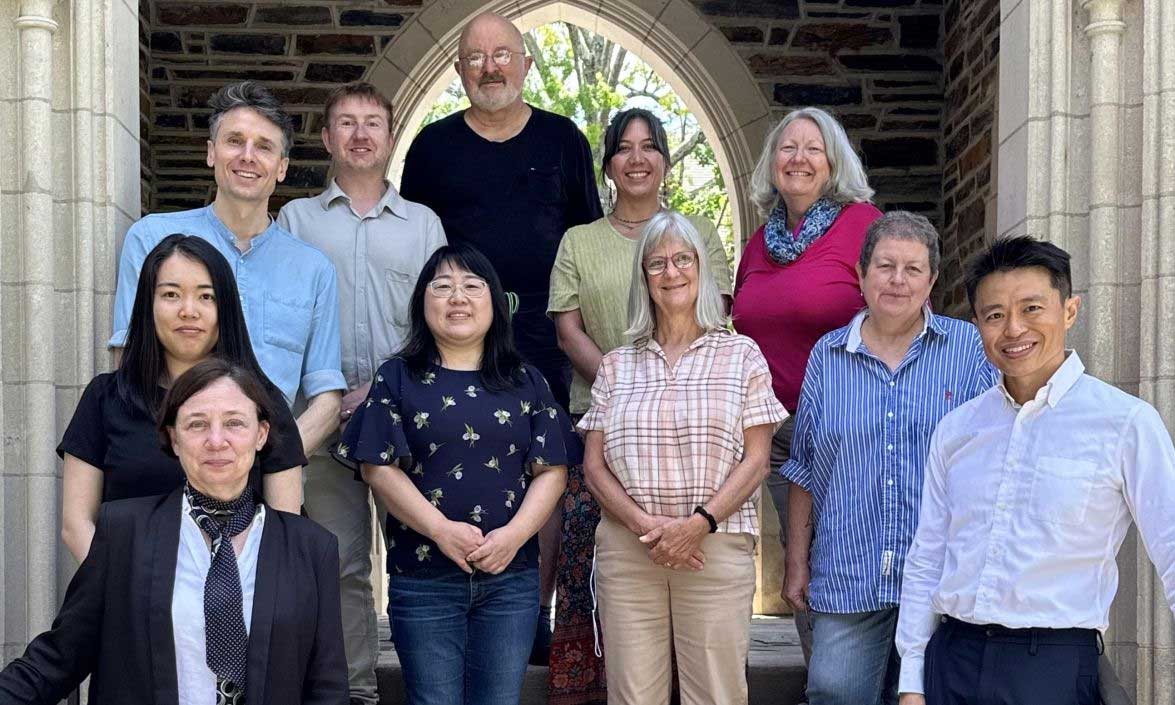
Renee Richer (front left) and Charles Chang (front right) with other 2024–25 CAST Fellows at Duke University. Photo courtesy of Duke Today.
The recognition, shared by Duke’s Office of Climate and Sustainability, highlights a full year of collaboration and curriculum development between Duke and DKU to strengthen climate and sustainability education across both campuses. Richer and Chang are the first DKU faculty members to participate in the CAST program.
Building climate education across campuses
As part of the fellowship, Richer and Chang completed a week-long workshop at Duke in May 2024 focused on climate science, sustainability, climate justice, applied learning and active teaching strategies. Throughout the academic year, they redesigned the DKU course INFOSCI 302: Urban Informatics and Sustainable Design, attended structured check-ins with Duke colleagues, contributed to a climate education resource library and helped foster a community of practice around climate teaching.
Richer said the experience strengthened connections between the two universities.
“The CAST program allowed for an exciting interchange that has led to further joint projects between faculty,” she said. “Having the opportunity to build relationships with faculty that are interdisciplinary in their thinking and work has resulted in greater outreach and success.”
Duke’s Office of Climate and Sustainability commended them for their contributions, noting DKU’s growing role in advancing climate teaching as part of the broader Duke Climate Commitment.
Turning cities into learning laboratories
The redesigned course invites students to examine how urban environments shape human and ecological well-being. Richer said she hopes students will see how urban design affects both conservation and public health.
“Urban environments play a crucial role in improving human well-being globally,” she said. “The design of the urban environment is also important in promoting human health, particularly addressing issues such as anxiety and depression.”
Chang said the course encourages students to link data analysis with real-world environmental action.
“Redesigning this course allowed us to bridge data science with ground-level sustainability action,” he said. “At DKU, we’re not just teaching theories. We’re empowering students to transform campus into a living lab for climate solutions.”
Supported by DKU’s Community-Based Learning Fund, Operations team, Student Affairs and the CAST program, the course blends lectures, fieldwork, design workshops and community-based learning.
Students gather and analyze environmental data, interview local residents, explore Suzhou’s classical gardens and develop sustainability proposals for sites across the DKU campus.
Student projects reach international audiences
The course’s applied approach has already produced strong student work. Under Chang’s supervision, Yucen Xiao ’27 and Yuandong Zhang ’25 created a WeChat mini program that tracks users’ carbon emissions and recommends low-carbon travel options. They refined their prototype through interviews with DKU students, faculty and nearby residents before training a deep learning model using global mobility data.
They presented their work at “Livable Cities 2025: Barcelona,” an Architecture Media Politics Society (AMPS) conference featuring international experts in urban sustainability.
“This project showed us that urban design isn’t just about data models,” Xiao said. “It’s about daily habits, community culture and people’s emotions.”
Strengthening DKU’s role in global sustainability work
Richer said DKU and Duke students are well positioned to contribute to climate solutions.
“With access to the best educational opportunities in the U.S. and China, Duke and DKU students are uniquely poised to learn about the disproportionate role of these two countries in global sustainability efforts and work toward implementation of solutions,” she said.
Both faculty members hope their participation in CAST will lead to more shared teaching models, faculty partnerships and student collaborations between Duke and DKU.
