The first thing passengers may notice is the floor.
Step into one carriage on Suzhou Metro Line 11, and the usual gray aisle gives way to a floor wrapped in images of grass and flowers. Overhead, images of blue sky, clouds and birds in flight stretch across the ceiling. Short messages hang from the green hand straps, inviting riders to rest their eyes, leave a little blank space in the day and let their minds slow down between stops.
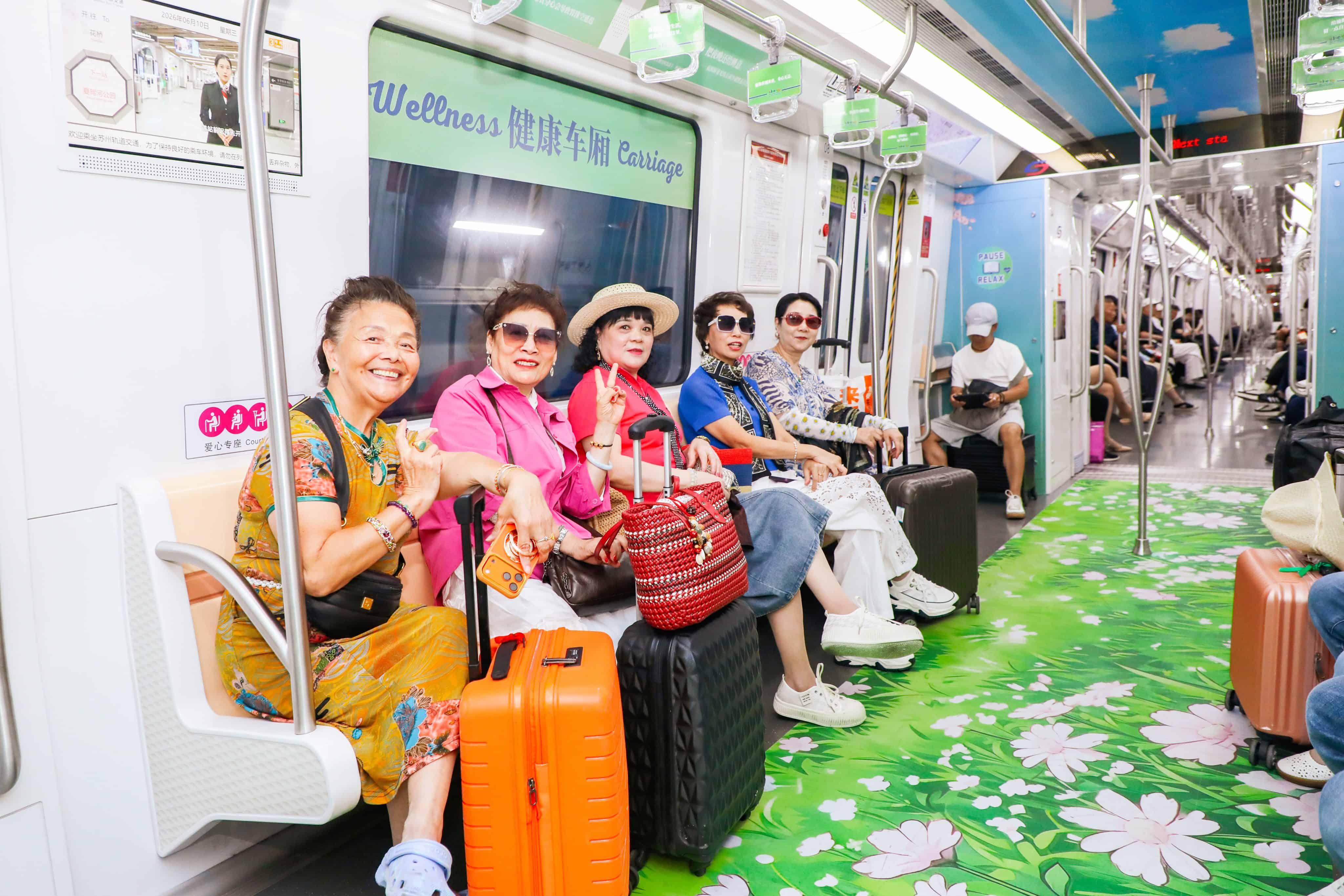
Not everyone notices. Some passengers still follow their usual commuting habits. But some do look up. A child points at the flowers. A pair of riders read the messages above them. Someone pauses, even briefly, before returning to the rush of the day.
For Duke Kunshan University undergraduates Jiaqi Chen and Tianruo Liu, that small pause is the point.
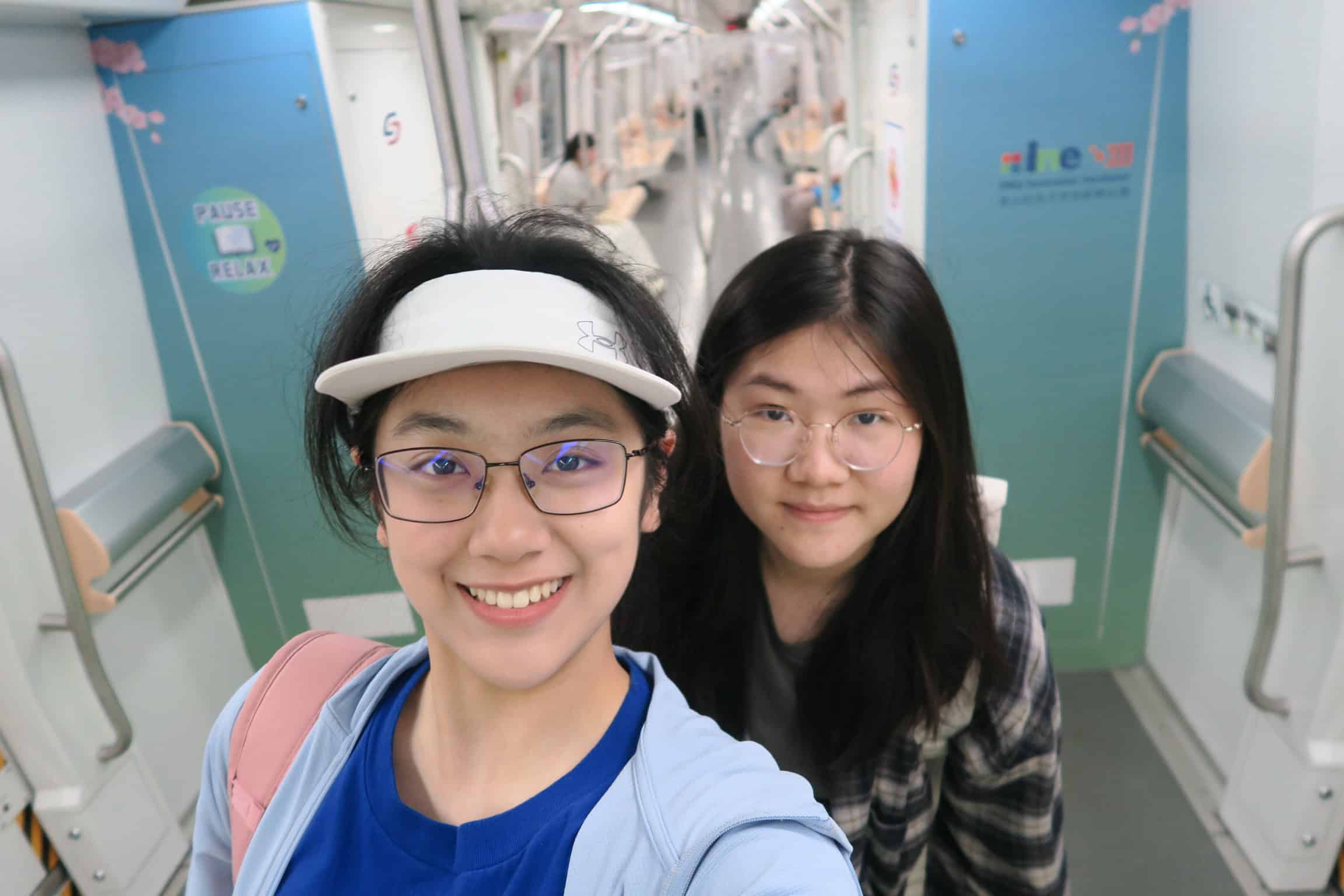
Jiaqi (left) and Tianruo
Their Wellness Carriage is a pilot project running through the end of June on Suzhou Metro Line 11, which runs through Kunshan and connects with the Shanghai metro network. The project is supported by DKU’s Innovation Incubator and guided by Claudia Nisa, assistant professor of behavioral science.
From restriction to invitation
The project grew out of Claudia’s Behavioral Science 101 course in fall 2025, where students first proposed a more direct intervention: seats reserved for passengers who were not using their phones. If riders wanted to sit and rest, they would need to put their phones away.
The idea was bold. In practice, it was not workable.
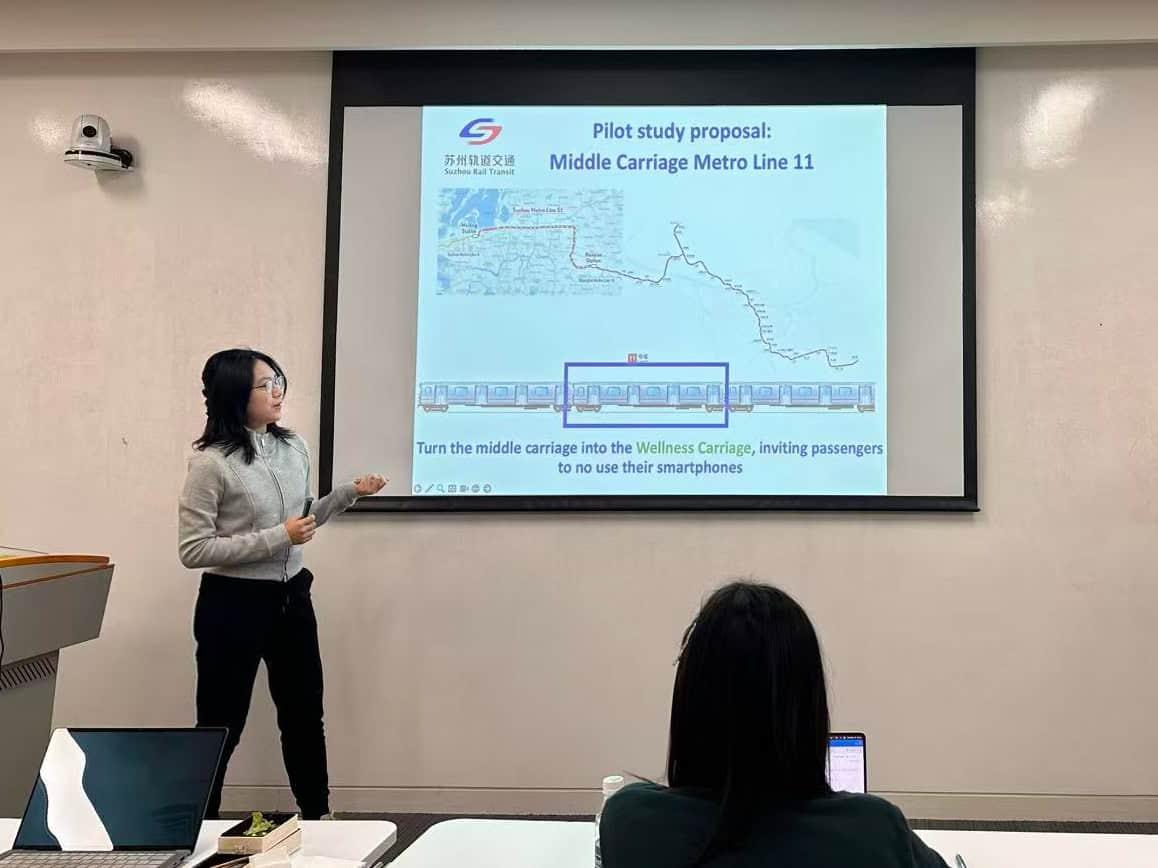
The metro operator did not approve restricting seats based on phone use, even in a single carriage. So when Jiaqi and Tianruo took the lead on the project, they had to rethink the approach. With Claudia’s guidance and after multiple discussions with metro representatives, the students moved away from restriction and toward invitation.
It would not tell passengers to stop using their phones. It would give them something else to notice.
“From the beginning, we wanted the carriage to feel supportive, not educational or demanding,” Tianruo said. “Our goal was not to tell passengers that they must put down their phones, but to gently remind them that commuting can also be a time to relax, observe and pay attention to themselves.”
That shift shaped the final design.
Nature imagery anchors the design: blue sky, white clouds and birds stretch across the ceiling, while images of grass and flowers cover the floor. Soft green appears throughout the carriage, including on the hand straps and side panels. The straps carry short wellness wishes collected from passenger surveys, with messages that invite riders to leave anxiety behind, care for their health and give their eyes and mood a short break.
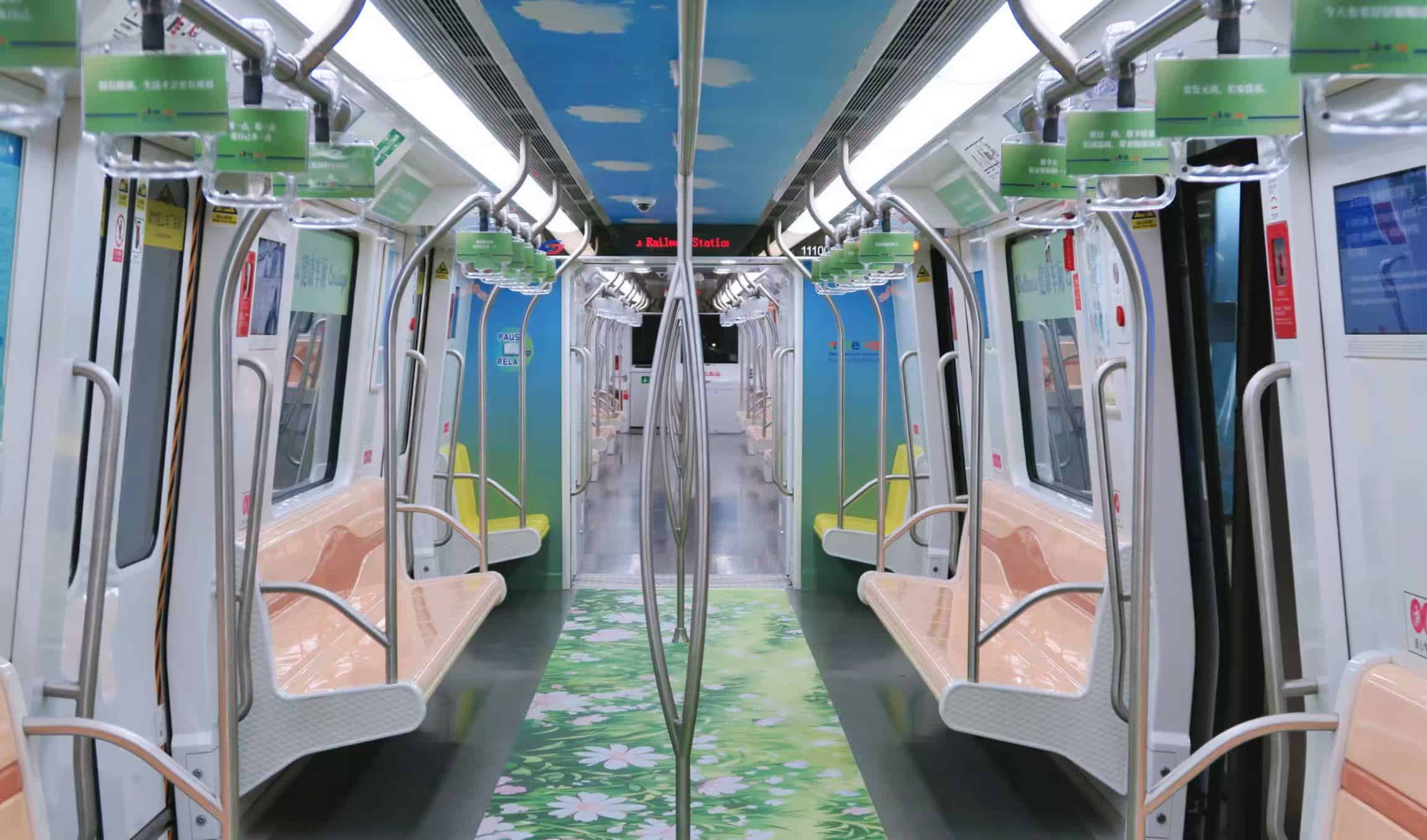
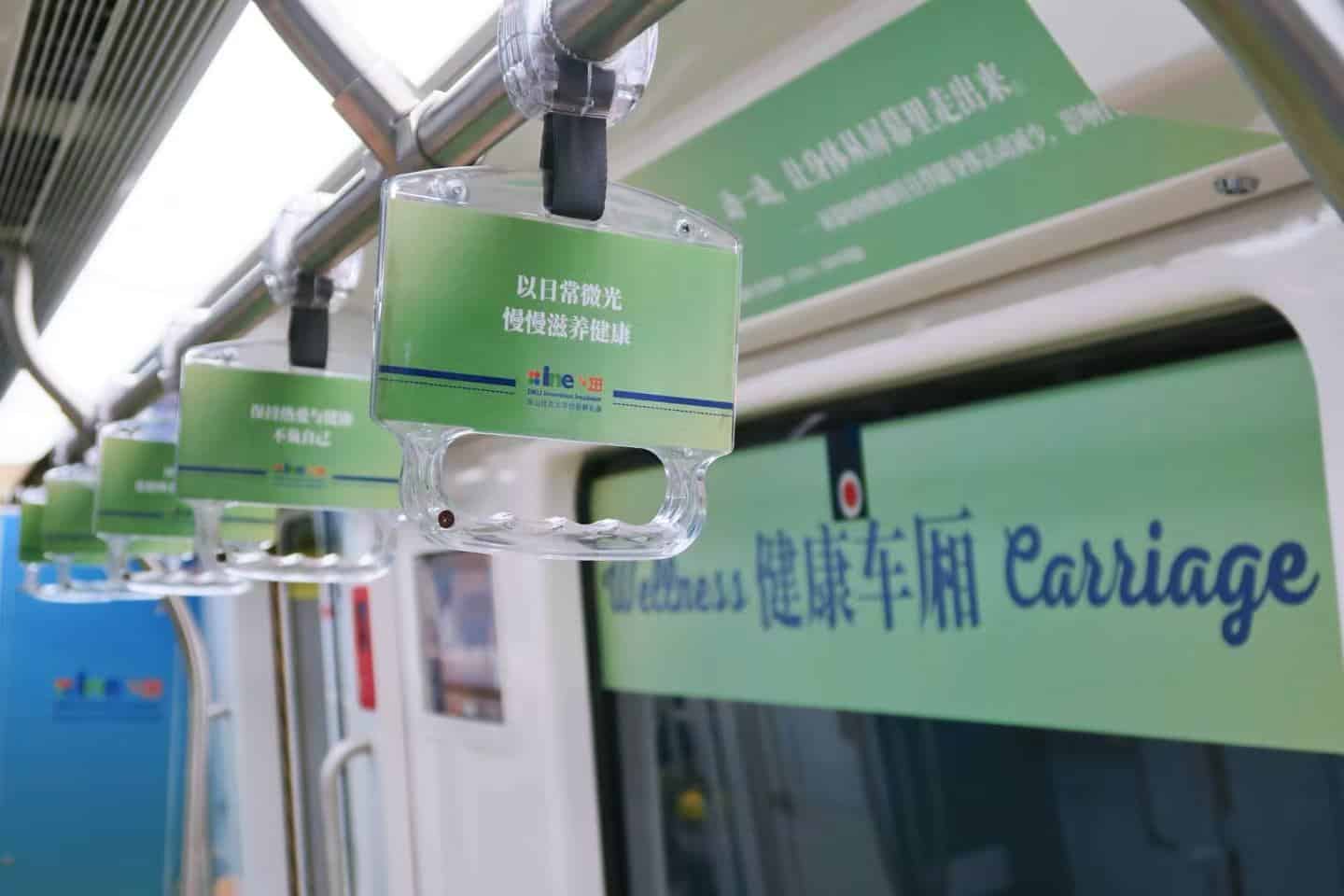
Side panels offer brief, research-informed tips on mental health, eye care and healthier commuting. The students worked to keep the language warm and benefit-focused, avoiding commands such as “don’t” or “should.”
For Claudia, the carriage is not simply decoration.
“The idea was not to make a cute carriage,” she said. “The idea was to use psychological principles and empirical data to explore how public transportation can be designed to feel more emotionally soothing.”
Claudia said the design drew on research suggesting that natural imagery, soft tones and calming colors can help create a more relaxing environment. The team hoped that if the space felt calmer, passengers might feel less need to reach automatically for their phones.
Designing for a real commute
Turning that idea into a real metro carriage took months of work.
Jiaqi and Tianruo began leading the project in December 2025. Over the following months, they conducted field observations, needs assessments, baseline surveys and data analysis before refining the spatial design and launching the pilot in June.
The hardest part, Jiaqi said, was not coming up with the design. It was finding a form of intervention that could promote healthier behavior without disrupting a busy public transit system.
“At the beginning, we thought more about how to promote health,” Jiaqi said. “During implementation, we kept asking how to promote health without disrupting passengers’ normal commute.”
That challenge changed how Jiaqi understood global health. In class, she had studied how the environment can shape health. In practice, she said, she learned that global health is not only about identifying health problems, but also about designing environments and policies that make healthier choices easier in everyday life.
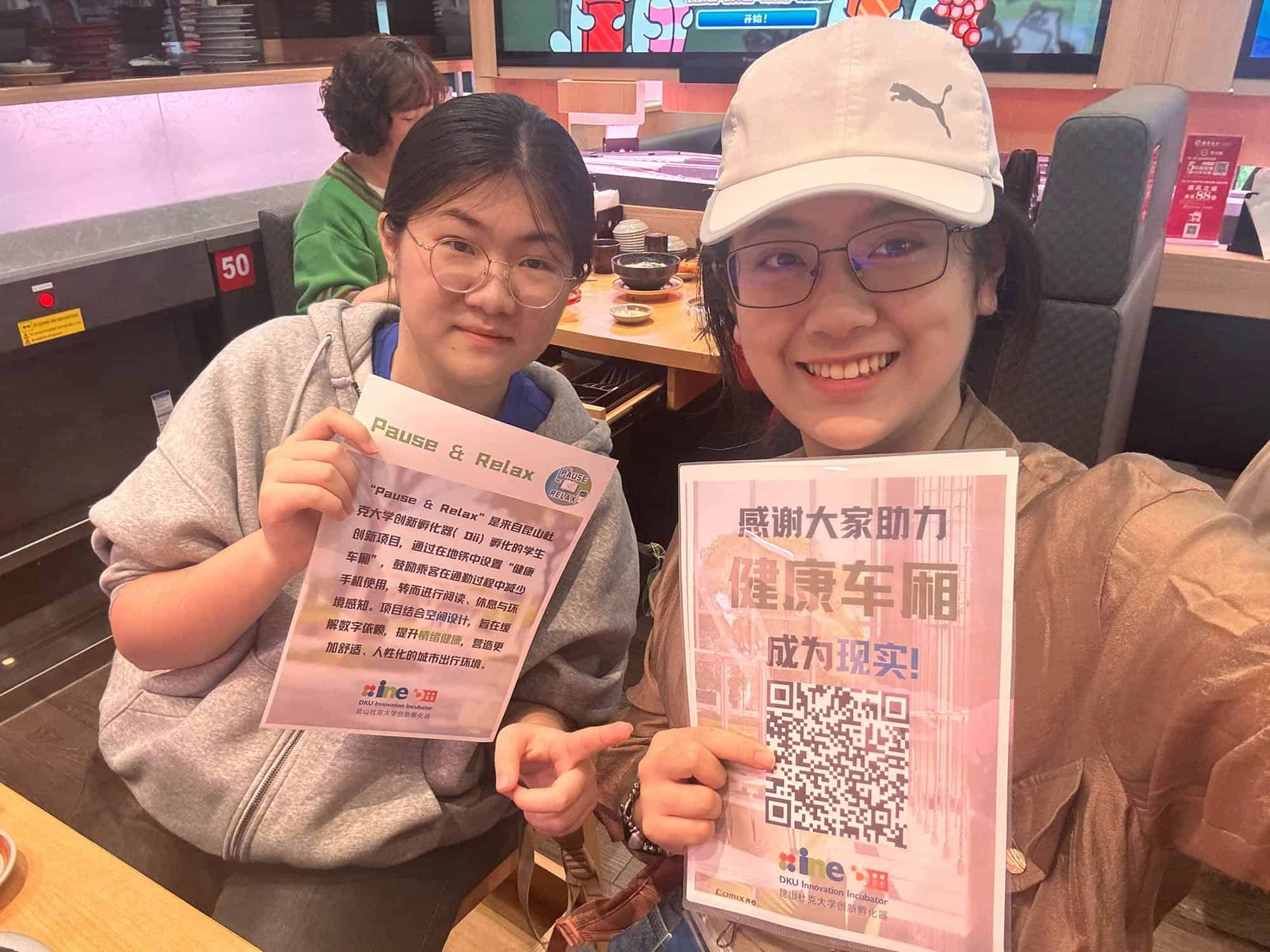
During the baseline survey stage, their original plan to collect responses inside a metro station could not proceed as scheduled. A delay could have thrown off the research timeline. After a brief period of anxiety, the students changed course and moved their survey work to the MixC area near Jiangpu Station on Line 11, where weekend foot traffic was high and people waiting in dining areas had more time to respond.
They approached strangers, explained the project and invited them to complete the survey. Some people were interested. Others declined or expressed doubts.
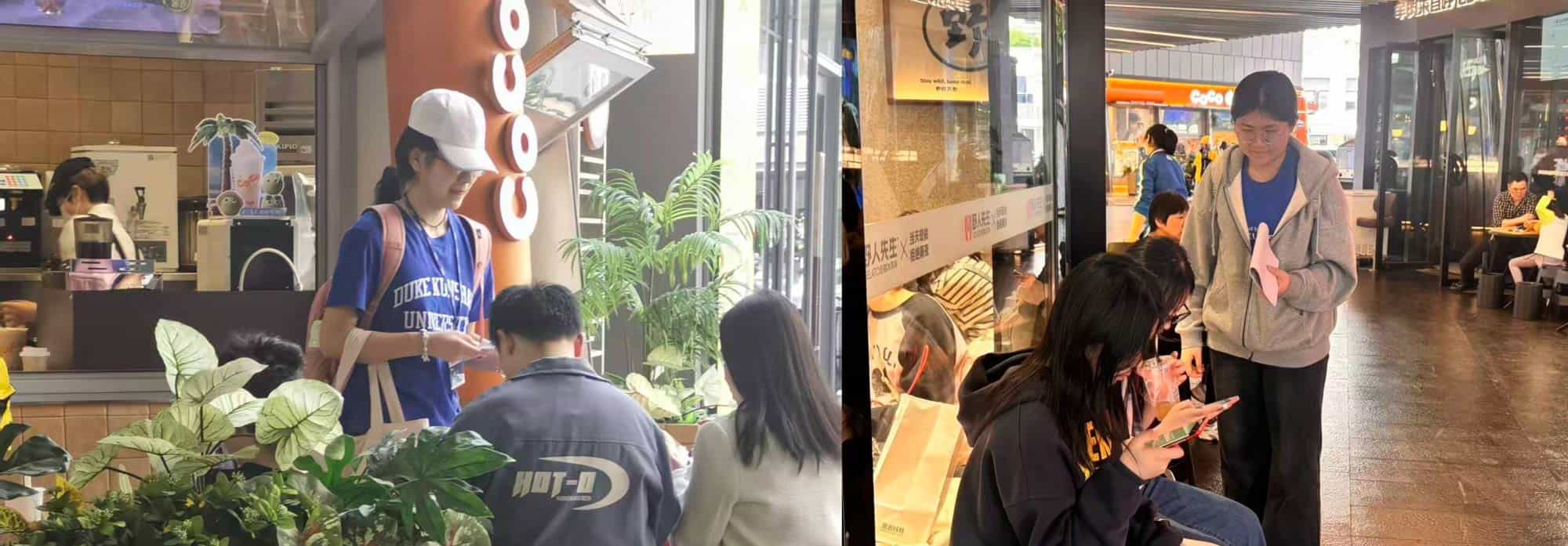
For Jiaqi, that setback became part of the lesson.
“It made us realize that social science research is not just about designing a questionnaire,” she said. “It is about building connections with different people in the real world, listening to different voices, and constantly adjusting research strategies and implementation plans according to reality.”
DKU’s Innovation Incubator provided funding, along with support for idea development, workshops, procurement and implementation. For the student team, Jiaqi said, that support helped move the project off the page and into a real public space.
Claudia said Jiaqi and Tianruo handled the process with dedication and patience, including months of direct communication with metro partners.
“They demonstrated dedication and commitment well above my expectations,” she said. “Most importantly, they were responsible for the direct contact with the metro over months of discussions, with professionalism and patience.”
A small pause
The team is still evaluating the pilot through behavioral observation, questionnaires, interviews, photos and video recordings.
One moment stayed with the students.
During one observation session, a young girl entered the carriage holding a phone. As she looked up to find her way, she noticed the images of grass and flowers on the floor. Then she looked again, taking in the ceiling, the text and other details around her. Her expression shifted into surprise and curiosity. Later, sitting with a friend, she pointed to the wellness messages and design elements as they talked and read together.
“When a space offers something worth noticing and exploring, people naturally lift their heads and shift their attention from the screen to their surroundings,” Tianruo said. “That is exactly the experience we hope the Wellness Carriage can create.”
For Jiaqi, the project also changed how she defines success in public health work.
At first, she believed the project would be difficult to call successful unless it significantly reduced passengers’ phone use. Over time, she began to see the goal differently. Habits this ingrained are unlikely to change through a single design intervention. Even the students themselves cannot promise they will never pick up their phones on the metro.
Jiaqi said the team does not expect carriage design alone to change people’s commuting habits. But she said the project has value if it helps even one passenger look up, pause at a wellness message, or spend a minute of the commute without being pulled into the phone.
Flowers on the floor and clouds on the ceiling cannot undo the pressures of urban commuting. The students know that.
But for them, that is enough to begin with. Their project gives passengers no rule to follow and no demand to change. It simply gives them, for a moment, a reason to look up.